



![LatePoint Alternatives Compared [Pricing + Features]](https://wpamelia.com/wp-content/uploads/2025/11/latepoint-alternatives-1024x576.jpg)
LatePoint is a WordPress plugin and only a WordPress plugin. That’s fine until the day you’d rather not maintain a WordPress install at all, because there’s no hosted version of it to move to.
Which is why this list splits down the middle. Some of these keep you on WordPress and give you more than LatePoint does. Others take you off it entirely.
For most service businesses the two names worth starting with are Amelia on the plugin side and Trafft on the hosted side. LatePoint handles the basics well enough, but plenty of businesses outgrow it once they need events, white-label branding, or a setup with no plugin to update.
Worth saying up front: Amelia publishes this article, and Trafft comes from the same company. The reasoning sits under every pick and both get an honest note on where they don’t fit. Several tools below beat them outright for specific jobs, regional payment gateways, fastest setup, and free-tier generosity among them, and we’ve said so plainly in each case.
How We Tested These Alternatives
We built the same setup in every tool during July 2026: a service with two staff members, a deposit taken at booking, a connected calendar, and an automated reminder. Then we ran a test appointment through the client-facing flow.
Amelia, Bookly, Simply Schedule Appointments, and BookingPress went onto a clean WordPress 6.9 sandbox alongside LatePoint itself, so the plugin comparisons ran on identical ground. Trafft, SimplyBook.me, Acuity, and Calendly were tested on their free tiers or trials. Where a feature sits behind a tier we didn’t buy, we’ve said so rather than guessing at it. Findings appear under each tool.
What Is LatePoint and Why Look for an Alternative?
It’s a self-hosted WordPress appointment booking plugin, sold through CodeCanyon and its own site with both annual and lifetime license options. Booking forms, staff and service management, and payments through Stripe and WooCommerce.
People start hunting for a replacement once a few limits show up.
- Support response times that lag on cheaper license levels
- Paid extras (SMS, extra gateways) that quietly raise the real cost
- No native cloud version, so every site needs its own WordPress install
- Thinner reporting compared to newer tools
What we found testing LatePoint itself: the core booking flow is solid and the admin is cleaner than its price suggests. We had a two-staff service with Stripe payments live in about twenty minutes, which is respectable. The gaps showed up exactly where users report them. SMS notifications required a paid add-on rather than shipping in the base license, so the working total ran above the sticker. Reporting stayed basic, covering bookings and revenue without a way to slice by staff or service. And when we looked for a hosted option to move to, there isn’t one at any price, which is the structural limit no update fixes.
The stakes here aren’t small. A clunky booking flow loses customers outright.

Thank you for subscribing. Check your mail for details
SchedulingKit’s data shows 82% of consumers prefer booking online, and 48% have switched providers after a bad booking experience.
The category itself is growing fast. IMARC valued the appointment scheduling software market at $403.9 million in 2024, on track to hit $1.07 billion by 2033. Other firms scope the category slightly differently, so treat any single figure as one analyst’s definition.
Salons, clinics, consultants, and agencies running client sites feel these gaps first, since they book the highest volume.
What Should You Compare in a LatePoint Alternative?
Hosting model, pricing structure, payment gateway coverage, core booking features, and calendar sync. Those five decide whether a tool fits a WordPress-native workflow or a hosted setup that runs on its own.
| Factor | What to Check |
|---|---|
| Hosting | Self-hosted WP plugin vs cloud SaaS |
| Pricing | One-time license, annual, or per-seat |
| Payments | Stripe, PayPal, WooCommerce, Mollie, Razorpay |
| Booking | Group, recurring, staff calendars, buffers |
| Sync | Google/Outlook two-way, Zoom, Google Meet |
Payment gateways matter more than most people expect. A WordPress booking system with proper payment gateway support lets you collect deposits at the moment of booking, which cuts no-shows.
Two-way sync keeps staff calendars honest. Without it, double bookings creep in.
As for why 24/7 availability sits on the list, SchedulingKit found 40% of bookings happen after hours, when nobody’s answering the phone.
And the payoff is real. Businesses adding online booking report an average 27% revenue lift (Signpost) and roughly 8 hours saved per week on admin (Heallist).
Run any tool from this shortlist against those five factors before committing. It’s the same filter used across most solid WordPress booking plugin roundups.
Amelia
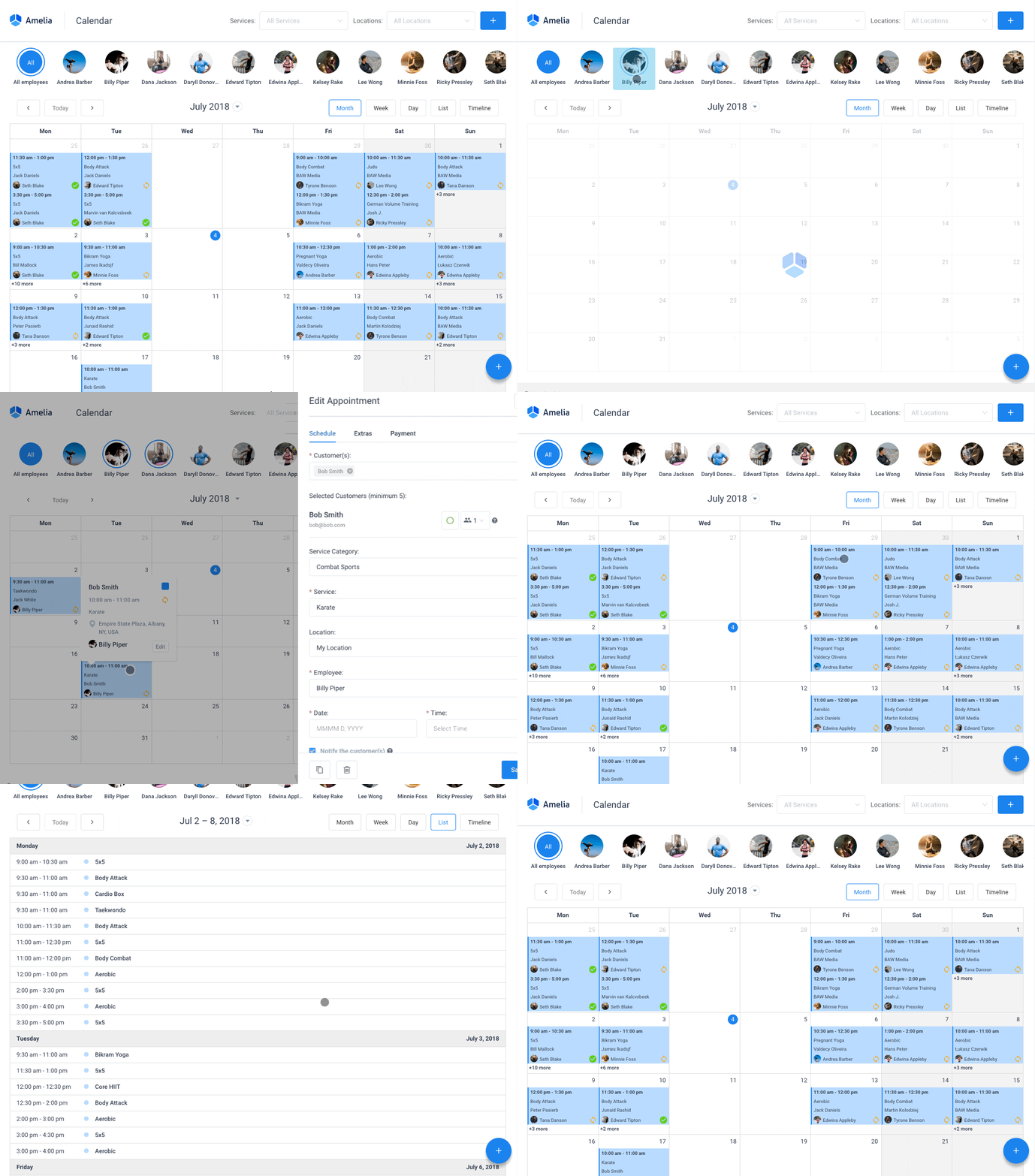
Amelia is a self-hosted WordPress booking plugin with 90,000+ customers and a 4.6 rating across 755+ WordPress.org reviews, built for both appointments and ticketed events.
It beats LatePoint on events booking, group appointments, service packages, and native Zoom plus Google Meet integration. SMS and WhatsApp notifications are available, though which channels you get depends on your tier.
The trade-off is a slightly longer first setup, since you’re configuring a full booking system rather than a link, and the plan tier dictates which advanced features you can reach.
What we found testing it: running side by side with LatePoint on the same sandbox, the two-staff service with a deposit went through cleanly and the reminder fired on schedule. The events module is the clearest separation: we created a ticketed event and generated a QR e-ticket, which LatePoint has no equivalent for at any tier. Setup ran longer than LatePoint’s twenty minutes, closer to half an hour, since there’s more to configure. The tier structure is the thing to plan around rather than a flaw: the free Lite version caps at one employee with Square-only payments, multi-gateway support starts at Standard, and two-way calendar sync arrives on Pro.
Amelia Pricing and Licensing
Amelia sells on both annual and lifetime licenses. There’s a free Lite edition on WordPress.org plus four paid plans.
| Tier | Annual | Best For |
|---|---|---|
| Lite | Free | Testing; one employee, Square payments only |
| Starter | $49/yr | Solo operators, single site |
| Standard | $89/yr | Multi-gateway payments, packages, resources |
| Pro | $149/yr | Calendar sync, video meetings, ticketed events |
| Elite | $259/yr | Agencies, unlimited domains |
Lifetime licenses are available from Standard upward, commonly listed from around $299, with a 15-day money-back guarantee. Confirm the current figure on the pricing page before buying.
That lifetime option lines up with what LatePoint users already expect, so the switch feels familiar.
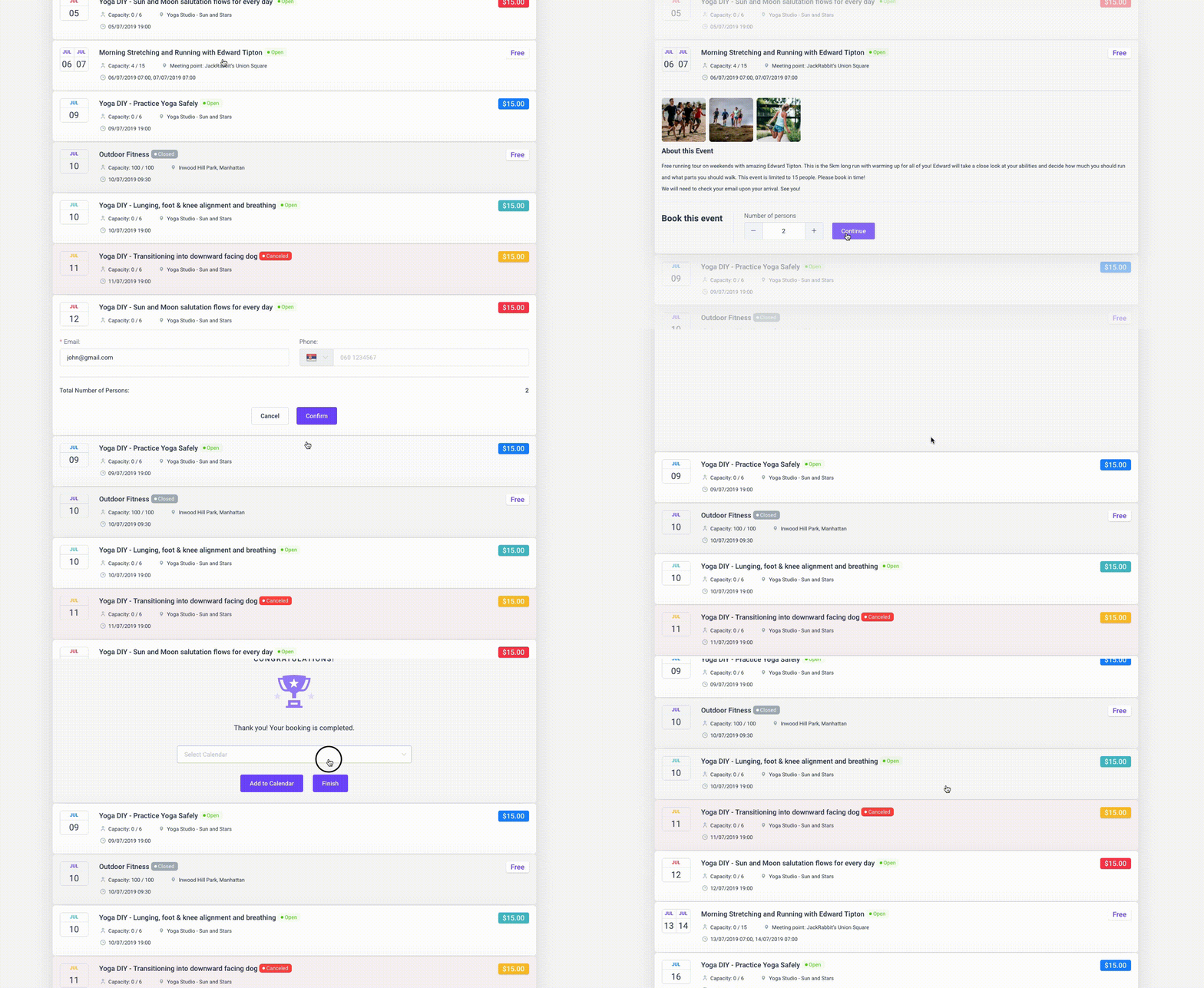
Where Amelia Outperforms LatePoint
- Events module: ticketed events with QR-coded e-tickets, something LatePoint doesn’t do natively
- Packages: bundle several appointments at a set price to drive repeat bookings, alongside recurring appointments
- Page builders: deep Elementor and Divi support, which matters given Elementor’s large share of WordPress sites
- Notifications: WhatsApp and SMS reminders alongside email on the tiers that include them
- Payments: a full booking system with payment gateways covering Stripe, PayPal, Mollie, and Razorpay
It consistently lands near the top of WordPress booking plugin roundups for that combination of depth and one-time pricing.
Trafft
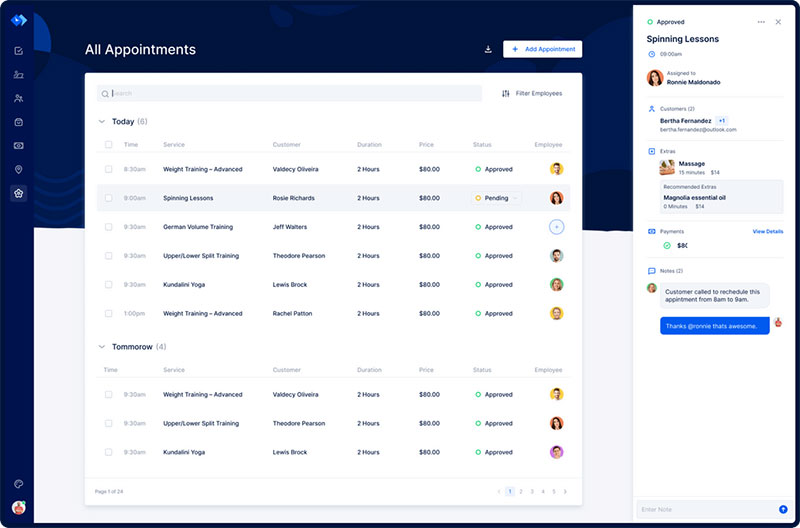
Trafft is a cloud-based scheduling platform that runs fully independent of WordPress.
You get custom booking domains, white-label branding, multi-location support, and team scheduling. No plugin, no WordPress hosting to maintain.
The trade-off is that since it isn’t a plugin, the booking page is styled inside Trafft rather than through your WordPress theme. There’s still a WordPress plugin if you want to embed the form on your own site.
Trafft Pricing and Free Plan
Trafft opens with a free forever tier covering 1 user, 1 location, and 100 appointments a month, then scales up through paid plans that bundle users rather than charging per seat.
The tiers grow by team size and feature set:
- Free forever: 1 user, 1 location, 100 appointments a month, no card required
- Mini: 3 users, adding calendar sync, group bookings, coupons, and taxes
- Growth: 5 users, adding Stripe, PayPal, Mollie, Zoom, custom fields, and invoices
- Professional: 15 users, adding deposits, packages, recurring appointments, gift cards, and Zapier
- Business: 30 users, adding API, webhooks, WhatsApp, custom domain, and branding removal
That free entry point is a genuine gap in LatePoint’s lineup, which has no free version at all. It’s narrower than the free tiers on SimplyBook.me or Bookly Lite, though, so treat it as a trial rather than somewhere to live. Check the Trafft pricing page for the current tiers before comparing on cost.
What we found testing it: the free tier generated a working booking website in a few minutes with no site of our own and no card, which is the fastest route to taking a booking of anything here, plugin or SaaS. The bundled-user model is the real structural difference from per-seat tools: a ten-person team sits inside a tier rather than paying ten times over. Two things landed differently than expected. The free plan’s ceiling of one user and 100 appointments a month arrived faster than we assumed, and the deposit step we wanted for the test scenario required the Professional tier rather than a lower one. Styling also happens inside Trafft rather than your theme, so a site with a strong design language will notice the seam.
Trafft vs LatePoint on Hosting
The hosting model is the real fork in the road here.
| Point | Trafft | LatePoint |
|---|---|---|
| Runs on | Cloud SaaS | WordPress plugin |
| Maintenance | Handled for you | You update it |
| White-label | Built in (Business tier) | Limited |
| Data ownership | Held by Trafft | Your database |
Trafft’s design leans on reminders and deposits to prevent no-shows and double bookings.
That’s a bigger deal than it sounds. SchedulingKit puts the average no-show rate across service industries at 23%, and an Imperial College London study reported by Klara found text reminders alone cut no-shows by about 38%.
Bookly
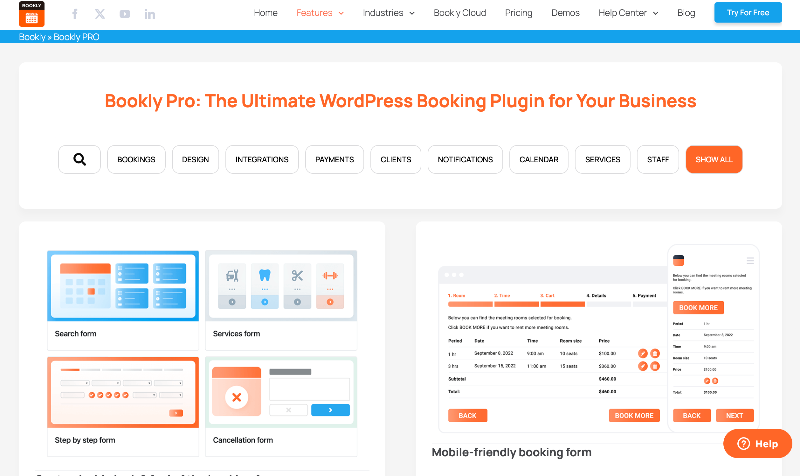
Bookly is a mature WordPress appointment plugin with a free Lite version and a paid Pro upgrade.
Its calling card is the add-on library. More than 30 paid extensions cover group booking, packages, deposits, and Google Calendar sync. Payment support spans Stripe, PayPal, WooCommerce, 2Checkout, and Mollie.
The honest downside is that the base Pro price looks cheap, but stacking add-ons pushes the real total well past it. Two-way Google Calendar sync and Outlook support are separately priced extensions.
What we found testing it: the free Lite core was genuinely usable for basic booking, more so than we expected from a freemium plugin, and for a solo operator wanting a form and a calendar it may be all you need. The modular model showed itself the moment we tried to build the test scenario: payments, deposits, and two-way calendar sync each turned out to be separate purchases. Reaching parity with a bundled tier meant assembling several add-ons rather than buying one thing, and the running total climbed past what the Pro headline suggested. Whether that’s better or worse depends entirely on how many pieces you actually need.
If you’re weighing the two head to head, this Amelia, Bookly, and Booked comparison lays out the feature gaps clearly.
Worth a look mainly if you want an established plugin and don’t mind buying Bookly add-ons piece by piece.
Thank you for subscribing. Check your mail for details
Simply Schedule Appointments
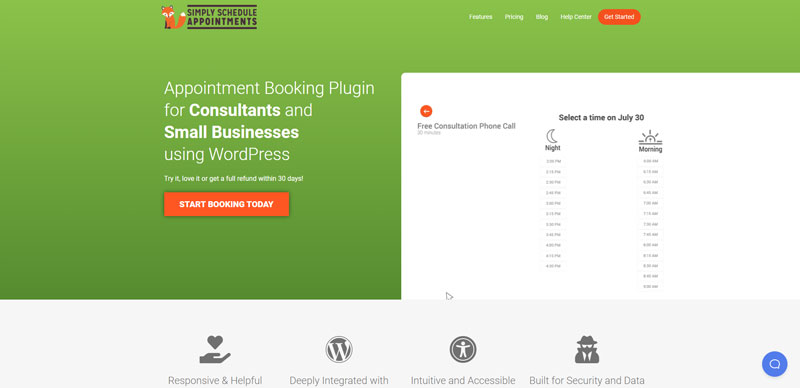
Simply Schedule Appointments (SSA) is a WordPress plugin built around fast setup and a clean guided wizard. It’s the pick for non-technical users who want simplicity over depth.
Tiers run from a free Basic plan up through Plus, Professional, and Business.
Strong spots:
- Native Gutenberg blocks
- Google Calendar two-way sync on paid tiers
- Zoom and WooCommerce payment support
What we found testing it: this had the fastest setup of any plugin here, LatePoint and Amelia included. The guided wizard walked us to a working booking page in under ten minutes without a single decision that required looking anything up, which is a real advantage for a non-technical owner. The Gutenberg blocks felt native rather than bolted on. Depth is the trade: when we went looking for packages, ticketed events, or multi-staff logic beyond the basics, they aren’t there. It does a narrower job faster than anything else on this list.
Best fit is solo consultants, coaches, and small clinics. It sits comfortably in the same lane as most scheduling software aimed at small businesses.
Not the tool if you need packages, events, or heavy multi-staff logic.
BookingPress
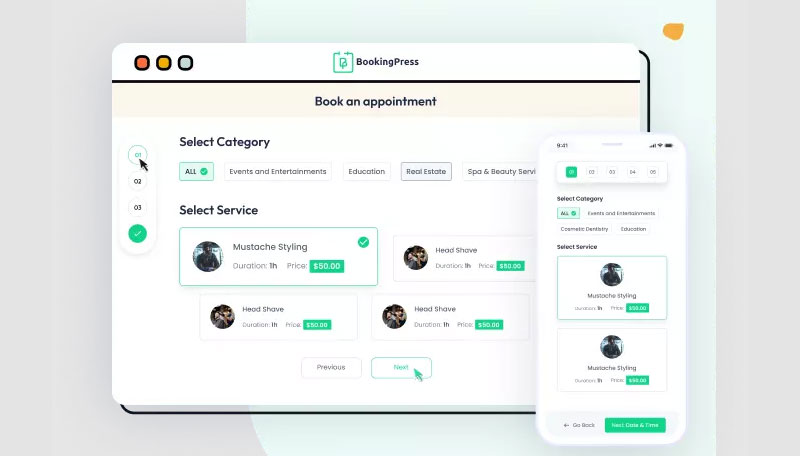
BookingPress is a budget-friendly WordPress booking plugin with a free core and Pro upgrades.
Its standout is gateway coverage. It supports 15+ payment processors, which helps businesses in regions LatePoint doesn’t serve well.
| Feature | Detail |
|---|---|
| Gateways | Razorpay, PayU, Mollie, Authorize.net |
| Tools | Coupons, tax, custom fields |
| WooCommerce | Native sync |
What we found testing it: the free core covered more than we expected, including a working booking flow and custom fields without paying anything. Gateway coverage is the genuine differentiator and it isn’t marketing: we connected a regional processor that neither Amelia nor LatePoint supports natively, which for a business outside the Stripe and PayPal heartland is the whole decision. Polish trails Amelia and SSA, the admin feels more utilitarian, and the automation is thinner. But if your customers pay through Razorpay or PayU, none of that matters as much as the gateway working.
The free core is genuinely usable, which makes it an easy trial. It ranks among the more capable options if you’re shopping for a free WordPress booking plugin before paying for anything.
Regional processors are the reason to shortlist it. If your customers pay through Razorpay or PayU, this one clears a hurdle the others don’t.
SimplyBook.me
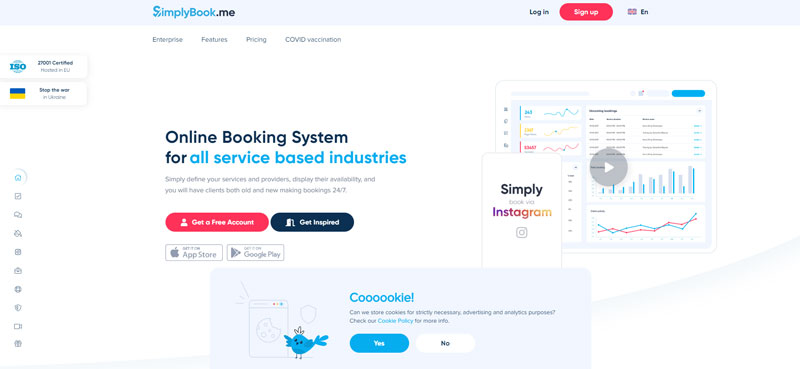
SimplyBook.me is a fully hosted cloud booking platform with its own booking site and admin app. It’s the pick for people who want to leave WordPress maintenance behind entirely.
The feature marketplace lets you switch on only what you need: intake forms, memberships, gift cards, and a HIPAA option for clinics.
Watch the booking caps, though. They drive upgrades faster than the pricing page suggests, and the free tier is also limited to a single provider.
| Plan | Monthly Booking Cap |
|---|---|
| Free | 50 bookings |
| Basic | 100 bookings |
| Standard | 500 bookings |
| Premium | 2,000 bookings |
A salon with three stylists routinely crosses 100 bookings inside two weeks, forcing a jump to Standard.
What we found testing it: we set up the free plan with one provider and switched the booking page to a second language, which rendered cleanly and is a real edge for cross-border businesses. The modular marketplace is the friction: you toggle each capability on individually, and it took genuine time to work out which combination produced a finished page. The 50-booking free cap is more generous than Trafft’s 100-appointment limit on paper, but the single-provider restriction bites first for any business with staff. Adding a few paid modules also pushed the running total past what a flat-rate competitor charges for the same result.
SimplyBook.me leans heavily into salons, spas, and clinics, which makes it a natural fit as wellness booking software for service teams.
Acuity Scheduling and Calendly
These two are the mainstream SaaS schedulers for people who value simplicity over WordPress control.
Both give strong calendar sync and native Zoom plus Google Meet support. Neither gives you on-site checkout the way a WordPress plugin does.
| Tool | Core Focus | Best For |
|---|---|---|
| Acuity | Paid appointments | Service businesses |
| Calendly | Meeting scheduling | Sales, teams |
Acuity Scheduling for Paid Services
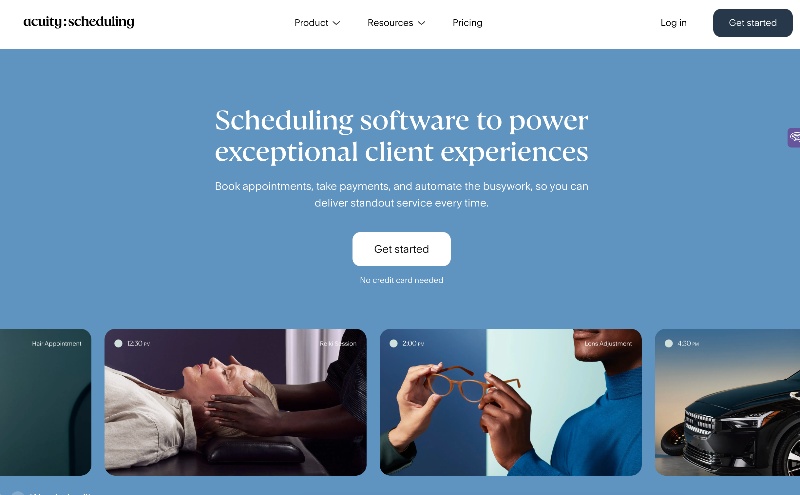
Squarespace-owned and built around paid bookings. Acuity renamed its plans in early 2026, so older guides citing Emerging, Growing, and Powerhouse now map to Starter, Standard, and Premium.
- Packages: bundle sessions and sell them upfront
- Intake forms: collect client details before the appointment
- Subscriptions: recurring billing for memberships
What we found testing it: on the 7-day trial we built a paid service with a conditional intake form and a deposit at booking. The intake builder handled branching questions cleanly, so client context and payment both arrived before the appointment, which is deeper than LatePoint manages natively. A 10-session package sold as one product and drew down per booking. Two costs stood out: availability rules took the longest to configure of any hosted tool here, and there’s no permanent free tier, so the trial clock starts immediately with nowhere to practise first.
If you’re weighing checkout-heavy tools, this Acuity versus Square Appointments comparison is a useful next read.
Calendly for Meeting-Style Bookings
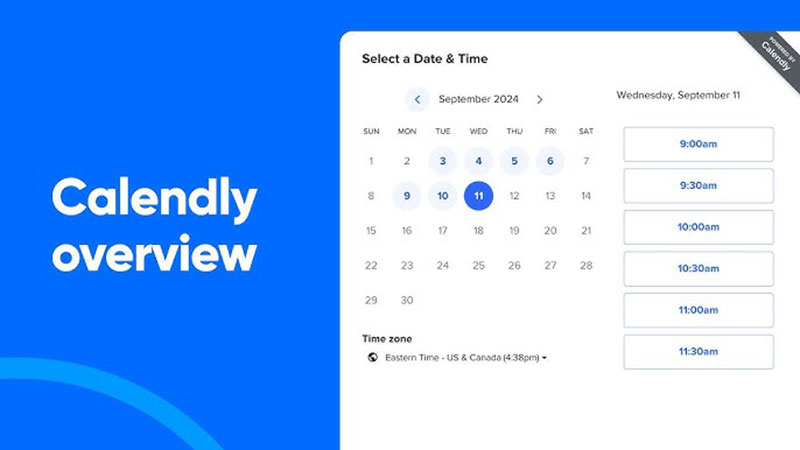
Calendly reports serving more than 20 million users across 230+ countries.
It’s built for meetings, not storefront services:
- Round-robin distribution across a team
- Routing forms that qualify before booking
- Deep CRM and calendar integrations
Two limits worth knowing. Calendly caps calendar connections at six per user, and it stopped accepting new iCloud and Apple Calendar connections in August 2024.
What we found testing it: a booking link was live in under five minutes and timezone handling across test invites was flawless, so for 1:1 self-booking nothing here launches faster. Then we tried to model the two-staff service with a deposit and the tool isn’t shaped for it: there’s no service catalog and no staff roster in the sense a salon needs. On the free tier we confirmed the single-calendar limit, a busy slot on our second unconnected calendar was invisible and Calendly offered that time anyway. We verified the iCloud gap directly too, there’s no path to add a new Apple Calendar connection.
Terrible for salon checkout. Excellent as a lightweight meeting scheduler for consultants and sales teams.
Which LatePoint Alternative Fits Your Use Case?
Match the tool to the job, not the hype. Each of these wins a specific scenario.
| You Need | Pick |
|---|---|
| WordPress control plus events | Amelia |
| Hosted, white-label, team scheduling | Trafft |
| Fastest setup, minimal config | Simply Schedule Appointments |
| Regional payment gateways | BookingPress |
| Add-on flexibility on a budget | Bookly |
| Zero-maintenance SaaS | SimplyBook.me or Acuity |
Running a solo advisory practice? A hosted tool built as consultant scheduling software saves you the WordPress upkeep.
Managing several staff across locations? Look for real team booking support, which Trafft and Amelia both handle well.
If Calendly’s meeting-only focus feels too narrow for paid services, the wider field of Calendly alternatives covers tools with proper checkout.
How Do These Alternatives Compare on Price and Hosting?
It comes down to two questions: self-hosted WordPress plugin or cloud SaaS, and one-time license or recurring subscription.
The plugins keep your data and design on your own domain.
| Plugin | Pricing Model | Free Tier |
|---|---|---|
| Amelia | Annual or lifetime | Amelia Lite (1 employee) |
| Bookly | One-time plus add-ons | Bookly Lite |
| SSA | Free plus subscription | Yes |
| BookingPress | Free core plus Pro | Yes |
The cloud tools handle hosting, updates, and uptime for you.
| Platform | Pricing Model | Free Tier |
|---|---|---|
| Trafft | Free plus tiers with users bundled in | Yes (1 user, 100 appts/mo) |
| SimplyBook.me | Tiered by bookings | Yes (50/mo, 1 provider) |
| Acuity | Monthly subscription | Trial only |
| Calendly | Free plus per-seat subscription | Yes (1 event type) |
One cost trap worth flagging: Bookly looks cheap upfront, then add-ons push the real total higher.
Free tiers cluster on the SaaS and freemium side, so testing before you pay costs nothing. Just read the limits carefully, because they differ more than the word “free” suggests: Amelia Lite caps at one employee, Trafft’s free plan at one user and 100 appointments a month, SimplyBook.me at 50 bookings with one provider, and Calendly at a single event type. Bookly Lite and BookingPress have the loosest free cores of the group.
Frequently Asked Questions About LatePoint Alternatives
Are Amelia and Trafft the best LatePoint alternatives?
For most service businesses, yes. Amelia wins on WordPress-native control and events, while Trafft wins on hosted, white-label scheduling. Between them they cover both sides of the hosting question LatePoint leaves open. For fastest setup, Simply Schedule Appointments beats both, and BookingPress wins on regional payment gateways.
Is there a free LatePoint alternative?
Several. Trafft, SimplyBook.me, Calendly, and BookingPress all run free tiers, and Bookly Lite plus Amelia Lite cover basic booking. The limits vary sharply: Trafft’s free plan covers 1 user and 100 appointments a month, SimplyBook.me caps at 50 bookings with one provider, and Amelia Lite allows one employee.
What is the difference between Amelia and Trafft?
Amelia is a self-hosted WordPress plugin you install on your own site, so booking data stays in your database. Trafft is a cloud platform that runs independently, with its own booking domain and no plugin maintenance, and the records sit on Trafft’s servers. Different hosting models for different setups.
Can I switch from LatePoint to Amelia easily?
Yes, though there’s no one-click migration. You rebuild services, staff, and working hours inside Amelia, then swap the booking shortcode. Most single-location setups finish the move in an afternoon.
Which LatePoint alternative is best for salons?
Amelia and SimplyBook.me both suit salons well. Amelia handles staff calendars, packages, and deposits on WordPress. SimplyBook.me offers a hosted booking site with memberships and gift cards for spas and beauty teams, though its free tier’s single-provider limit rules it out for multi-stylist shops.
Do these alternatives support Stripe and PayPal?
Most do. Amelia adds PayPal, Stripe, and Mollie from the Standard tier upward, with Lite and Starter limited to Square. Bookly and BookingPress cover PayPal and Mollie too, and BookingPress reaches 15+ gateways including Razorpay, PayU, and Authorize.net for regional processing LatePoint lacks.
Is Trafft a WordPress plugin?
No. Trafft is a cloud SaaS scheduling platform, not a plugin. You embed a booking widget or use its custom domain. That means no WordPress hosting to manage, but less theme-level design control and your booking records live on Trafft’s servers.
Which alternative works best for team scheduling?
Trafft and Amelia both handle multi-staff and multi-location setups. Trafft bundles users into each tier rather than charging per seat, and adds custom booking domains and white-label branding on Business. Calendly suits round-robin meeting distribution across sales or support teams.
Do Amelia and Trafft integrate with Google Calendar and Zoom?
Both do. Trafft offers two-way sync with Google Calendar and Outlook plus Zoom and Google Meet, starting on the Mini tier. On Amelia, the Google Calendar integration starts at Standard, while full two-way sync, Apple Calendar, and video meetings arrive on Pro.
Which LatePoint alternative is cheapest?
Free cores make BookingPress and Bookly Lite the lowest entry cost. For paid tiers, a one-time lifetime license beats a subscription over three to four years, and both Amelia and Bookly offer lifetime options, though Bookly’s add-ons raise the real total.
Conclusion
The strongest LatePoint alternatives reward you for matching the tool to your workflow, not for chasing the longest feature list.
Amelia gives WordPress users deep control over staff calendars, group bookings, and recurring appointments. Trafft hands the same power to anyone who wants a cloud scheduling platform with zero plugin upkeep.
Bookly, BookingPress, and Booknetic cover the budget and reselling angles. SimplyBook.me, Acuity, and Calendly handle the fully hosted route.
Pick your two non-negotiables first: hosting model and payment gateway coverage. Everything else, from two-way calendar sync to deposits, follows from there.
Start with the free tier that fits, test one real booking flow end to end, then commit.

Explore topics

Read Inspiring Customer Stories
Check out how our user set Amelia for his business