



Missed meetings cost businesses more than just time. Momentum breaks. Decisions get delayed. And slowly, professional relationships start to suffer.
A well-timed reminder fixes most of that.
But most people either skip reminders entirely or send a message that is so bland it gets ignored. “Just a reminder about our meeting tomorrow” is a bit useless and most likely will be ignored.
This article covers practical meeting reminder examples for every format and context: email, SMS, calendar notifications, Slack, and Teams.
You’ll also find templates for recurring meetings, no-show follow-ups, and the tools that handle all of this automatically, including our very own Amelia.
Free Meeting Reminder Email Generator
What Is a Meeting Reminder
A meeting reminder is a scheduled message sent before a meeting starts. The job is simple: confirm the time, provide the details, and reduce the chance someone forgets or shows up unprepared.
Simple enough, but that second part matters more than people realize. According to research from Huron Learning Lab, automated email reminders reduce no-shows by 25%. Direct phone or text reminders push that number even higher.
A good reminder does two things:
- Informs attendees: date, time, location or video link, and the meeting’s purpose
- Prompts action: confirm attendance, join the call, or prepare something beforehand
And it’s worth making a quick distinction here. A meeting invitation creates the event. A reminder references something that already exists and is coming up soon. Different purpose, different tone.
Reminder formats
The same message gets delivered differently depending on the tool or channel.
| Format | Primary Use Case | Common Tools |
|---|---|---|
| External clients, formal meetings | Gmail, Outlook | |
| Calendar notification | Internal teams, recurring meetings | Google Calendar, Apple Calendar |
| SMS / text | High-urgency, mobile-first recipients | Twilio, Calendly, HubSpot |
| Messaging platform | Remote teams, async-first orgs | Slack, Microsoft Teams |
| Booking-triggered reminders | Appointment-based businesses | WPAmelia, Calendly, Acuity |
Each format serves a different audience. The channel you pick affects open rates, response speed, and overall tone. SMS messages, for example, are opened by 98% of recipients, compared to roughly 37% for email (Notifyre, 2025).
Where booking tools fit in
Most reminder systems work best when they’re tied directly to your booking flow. That’s where a tool like Amelia becomes relevant, especially for WordPress-based businesses.
Amelia is a WordPress booking plugin that handles both appointments and events. It comes with built-in automated notifications and reminders sent via email and SMS, so you’re not manually chasing confirmations or setting up separate automation tools.
What Amelia handles on the notification side
- Automated email and SMS reminders triggered at specific intervals before an appointment or event
- WhatsApp notifications (available on Pro and Elite licenses) for businesses where clients prefer that channel
- Custom notification templates so the message matches your brand tone
- Notifications sent to both customers and employees separately
That last point matters more than people think. I’ve seen setups where the client gets reminded but the staff member doesn’t, and things still fall apart. Amelia sends to both sides of the booking by default.
Beyond reminders
The notification system is just one part. Amelia also connects with Google Calendar, Outlook, and Apple Calendar for two-way sync, plus Zoom, Google Meet, and Microsoft Teams for virtual appointments. So the reminder doesn’t just tell someone to show up, it links directly to the meeting or includes the location.
Payment confirmations are also part of the flow. Amelia supports PayPal, Stripe, Mollie, Square, and WooCommerce, and sends payment-related notifications automatically. If someone pays a deposit, they get a confirmation. If a refund is issued (Pro/Elite), that’s communicated too.
Who actually uses it
Amelia targets a pretty wide range of businesses: beauty salons, medical practices, gyms, photographers, coaches, event agencies. Over 90,000 customers use it, which is a decent signal that the setup isn’t overly complicated.
The step-by-step booking wizard on the front end is clean. Clients pick a service, an employee (if relevant), a date and time, then pay. The whole flow generates the right notifications at each stage without you touching anything after the initial setup.
Pricing structure
Amelia has four tiers (annual and lifetime options):
- Starter – core booking features, 1 domain
- Standard – recurring bookings, online payments, calendar integrations, 1 domain
- Pro – service packages, resource management, event waiting lists, multi-service booking, 5 domains
- Elite – REST API access, WordPress and JavaScript hooks, unlimited domains
WhatsApp notifications, Stripe Connect, and resource sharing are Pro/Elite-only. If those matter for your workflow, factor that into which plan makes sense.
For teams already on WordPress looking for a booking system that handles reminders natively, without patching together five separate tools, Amelia covers most of what you’d need out of the box.
When to Send Meeting Reminders
Timing determines whether the reminder actually does its job. Send it too early and it gets buried. Too late and the person is already mid-commute or in another call.
Harvard Business School lecturer Julia Austin recommends scheduling meetings with at least 24 hours’ notice, with more time being better whenever possible (Fellow State of Meetings, 2024). That same window applies to reminders.
Standard timing windows
24 hours before is the most reliable send time for most business meetings. It gives attendees enough time to block their schedule, review the agenda, and prepare materials without the reminder being forgotten overnight.
1 hour before works as a second reminder for external clients or high-stakes meetings. Brief, specific, and focused only on the join link and time.
15 minutes before is best reserved for automated calendar pings in Google Calendar or Outlook. Not a full message, just a nudge.
How meeting type affects timing
A weekly internal standup doesn’t need a 24-hour email. A quarterly review with a client does. Here’s the practical difference:
- Internal recurring meetings: one calendar notification, 15-30 minutes before
- One-off internal meetings: single email, 24 hours before
- External client calls: email 24-48 hours out, plus a short SMS or second email 1 hour before
- Interviews: reminder to both parties 24 hours before, plus confirmation request
Also, 40% of all product management meetings are booked with less than 24 hours’ notice (Fellow, 2024). For last-minute meetings, send the reminder immediately after scheduling, with a short note explaining the urgency.
Time zones
Always include the time zone in the reminder body, not just the subject line. If your attendees are spread across regions, write it out clearly: “3:00 PM ET / 12:00 PM PT.” Calendly and Google Calendar handle this automatically when attendees book through a scheduling link, but manually written reminders often skip it.
What a Good Meeting Reminder Includes
Most bad reminders fail not because they’re late, but because they’re incomplete. Attendees show up without the dial-in number, or they realize mid-message they’re not sure which Zoom link to use.
Every reminder needs these five things:
- Date and time (including time zone)
- Location or meeting link (the actual clickable link, not just “Teams”)
- Meeting purpose or agenda (even one sentence is better than nothing)
- Who called the meeting (especially for external attendees)
- What to do if plans change (reschedule link or contact)
Optional but useful additions
Dial-in numbers, passcodes, prep instructions, or attached documents all reduce friction on the day of the meeting.
For a client meeting, adding “please review the attached proposal before we connect” turns the reminder into a prep tool. That’s the difference between a transactional notification and something genuinely useful.
Tone calibration
| Context | Tone | Example Opener |
|---|---|---|
| External client | Professional, warm | “Just confirming our call tomorrow…” |
| Internal team | Direct, casual | “Quick heads-up about tomorrow’s standup…” |
| Job interview (recruiter) | Friendly, structured | “Looking forward to speaking with you tomorrow…” |
| Executive/senior stakeholder | Formal, concise | “This is a reminder for our scheduled call…” |
Length follows context. Internal reminders can be three sentences. External client reminders often need a bit more structure, especially when joining instructions are involved. Maintaining professionalism and friendliness in your tone is the balance most people struggle with, but it mostly comes down to word choice and sentence length.
Meeting Reminder Email Examples
Email is still the most common channel for pre-meeting notification, and the right appointment confirmation message can make a real difference in attendance. Below are practical templates for the most common scenarios.
Formal meeting reminder email examples
Use these for external clients, stakeholders, or any meeting where the relationship is still early-stage. Before sending, run the copy through an AI grammar checker to catch awkward phrasing, especially in templates you reuse often.
Client meeting reminder
Subject: Reminder: [Meeting Topic] Tomorrow at [Time]
Hi [Name],
> Just a quick reminder about our call tomorrow, [Date], at [Time] [Time Zone]. > We’ll be covering [agenda topic]. The meeting link is below: > [Meeting Link] > If you need to reschedule, you can do so here: [Link]. Otherwise, looking forward to speaking with you. > Best, [Your Name]
Interview reminder (recruiter to candidate)
Subject: Your Interview with [Company] Tomorrow, [Time]
Hi [Candidate Name],
> This is a reminder for your interview with [Company] tomorrow, [Date] at [Time] [Time Zone]. > You’ll be meeting with [Interviewer Name], [Title]. The call will take place via [Zoom/Teams/Phone]. Join using this link: [Link] > Please reach out if anything comes up. We look forward to chatting. > [Your Name], [Title]
Informal internal reminder email examples
These work for team meetings, standups, and internal syncs where people already know the context.
Internal team meeting
Subject: Quick reminder: Team sync tomorrow at [Time]
Hey team,
> Heads-up for tomorrow’s sync at [Time] [Time Zone]. We’re covering [topic 1] and [topic 2]. > Link: [Meeting Link] > See you there.
Follow-up reminder for non-responders
Subject: Still on for [Meeting Topic] tomorrow?
Hi [Name],
> Just checking in since I haven’t heard back. We have [meeting topic] scheduled for tomorrow, [Date] at [Time]. > Let me know if you’re still able to join or if you’d like to reschedule. Either works. > [Your Name]
That last one is easy to overcomplicate. Keeping it short and giving the person a clear out (reschedule vs. confirm) almost always gets a faster response than a long explanation. Think of it as a follow-up email that doubles as a soft confirmation request.
Say goodbye to missed appointments with Amelia
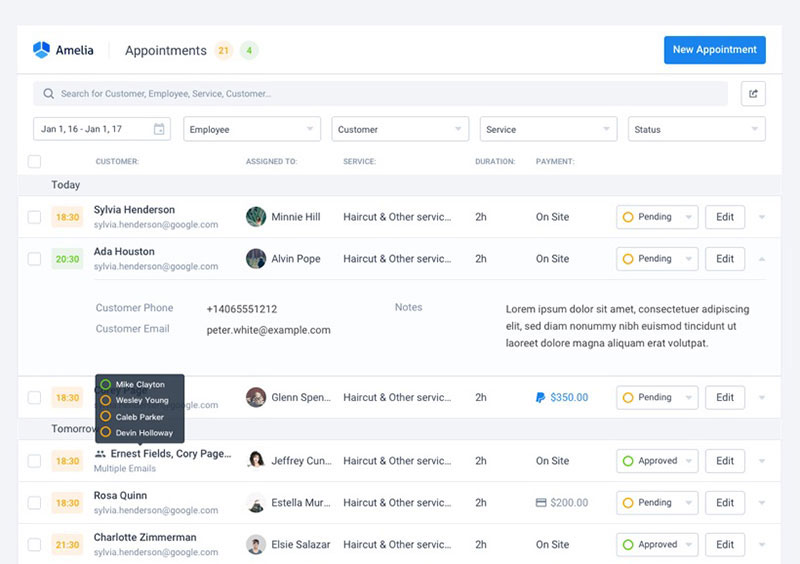
Discover the power of the Amelia booking plugin – your go-to tool for automating meeting reminders and simplifying the entire appointment booking process!
Here’s why Amelia stands out:
Automated scheduling: Set up seamless booking workflows on your website, allowing clients to schedule appointments effortlessly. Once booked, Amelia automatically dispatches confirmation emails with vital meeting details like date, time, and location.
Reminder notifications: Customize automated reminders to go out before scheduled meetings, ensuring participants are always in the loop. Choose the timing that suits you – be it a 24-hour heads-up or a nudge just an hour before the appointment.
Five event notifications: Stay on top of events with Amelia’s five notification types – from bookings and reschedules to cancellations by attendees or admins, and handy next-day reminders.
Personalization: Elevate customer experience by personalizing meeting reminder emails. Amelia’s dynamic fields let you tailor information for each meeting and participant, making communication more engaging and customer-centric.
Rescheduling and cancellations: Seamlessly handle changes with Amelia. It automates rescheduling notifications, updates calendars, and even suggests alternative time slots. No confusion, just clear communication.
Centralized management: Amelia brings all your appointments, reminders, and client details into one organized dashboard. Stay on top of your schedule, track attendance, and manage your appointments with ease.
Ready to say goodbye to appointment hassles? Try Amelia today and streamline your booking process effortlessly!
Calendar Invite Reminder Message Examples
Calendar notifications work differently from email. The message appears in a pop-up or lock screen notification, so you have maybe two seconds to land the key point before it’s dismissed.
Google Calendar and Outlook both let you customize the event description, the event title, and the notification timing. Most people only edit the title, which is a missed opportunity.
Writing the event title as a mini-reminder
The title is the first thing people see in their calendar. Use it to carry information, not just label the meeting.
- Weak: Meeting with Sarah
- Better: Sarah (Acme) – Q3 Review Call – Zoom
- Best: Sarah (Acme) | Q3 Review | 2pm ET | Zoom link in description
That third version tells the attendee the person, purpose, time, and where to find the link, all before they even open the event.
Event description examples
Google Calendar event description (internal meeting)
Weekly product sync – 30 min
> Agenda: Sprint updates, blockers, next week’s priorities > Join: [Meet link] > Dial-in: [Number] | Code: [Code]
Outlook calendar invite (external client)
Hi [Name],
> Looking forward to our call. Details below: > Date: [Date] Time: [Time] ET Join Teams: [Link] Agenda: [Topic 1], [Topic 2] > Please reply if you need to adjust the time.
One thing worth noting: the character limit on calendar notification pop-ups is short. Keep the most critical info (link + time) in the first two lines of the description. Everything else is secondary.
WPAmelia automates most of this if you use it for scheduling appointments through Google Calendar, populating the description, link, and time zone data automatically for both parties.
Meeting Reminder Text Message Examples
SMS is the most direct channel for pre-meeting reminders. The numbers back this up: 76% of consumers subscribe to business texts specifically for appointment and reservation reminders (SimpleTexting, 2025).
Text reminders are read fast, ignored rarely, and don’t require the recipient to open an app or scroll through an inbox.
When SMS reminders make sense
Not every meeting needs a text reminder. The channel works best when:
- The recipient is external (client, candidate, partner)
- The meeting is high-stakes and no-shows carry a real cost
- You’ve already tried email and got no response confirmation
- The meeting is a web conference and the join link needs to be easily accessible on mobile
- You’re already using tools to automate email reminders but want a higher-visibility backup channel for critical meetings
Internal teams rarely need SMS reminders. That’s what Slack and calendar pings are for.
SMS reminder copy examples
Client meeting (same day)
Hi [Name], reminder: your call with [Company] is today at [Time] [TZ]. Join here: [Short link]. Reply STOP to opt out.
Appointment reminder (24 hours before)
[Name], you have a scheduled meeting tomorrow at [Time] with [Person/Team]. Details: [Link]. Text back to confirm or reschedule.
No-confirm follow-up text
Hey [Name] – still on for our [Time] call today? Reply YES to confirm or let me know if you need a new time.
Brief automated SMS (WPAmelia, HubSpot)
Reminder: [Meeting Title] starts in 1 hour. Join: [Link]
Character limits and format rules
Standard SMS caps at 160 characters. Most reminder tools send longer messages as linked MMS, but keeping under the limit ensures delivery on every carrier and device.
The practical rule: time, link, and a way to respond. Everything else is extra. Tools like WPAmelia, HubSpot, and Twilio let you automate these with merge fields so the name, time, and link populate automatically.
If your business handles frequent client appointments, pairing SMS with a dedicated appointment reminder app saves hours and removes the risk of manual sends going out late or to the wrong person.
Slack and Teams Meeting Reminder Examples
Slack has 47 million daily active users as of 2025, and businesses using it report a 27% reduction in meeting volume (Electroiq, 2025). That’s a lot of people already living inside these platforms when a reminder lands.
Which means a Slack or Teams ping lands differently than an email. The tone is looser, the message is shorter, and nobody expects a formal sign-off.
When to use a direct message vs. a channel post
Direct message: Use for one-on-one meetings, sensitive topics, or any time you’d normally send an individual email.
Channel post: Better for team meetings, recurring syncs, or when you want the whole group to see the reminder at once.
Tagging someone with @mention in a channel is fine for standups. For a client-facing call that happens to be managed over Slack Connect, send a DM.
Slack reminder message examples
These work well as human-written messages. Most teams also use bots like Geekbot or the native Slack reminder command (/remind) to automate recurring ones.
Internal team reminder (channel post):
Hey @team, quick heads-up: sprint review is tomorrow at [Time]. Agenda is in the thread. Drop any blockers there before we meet.
One-on-one DM reminder:
Hi [Name], just flagging our call tomorrow at [Time] [TZ]. Zoom link: [Link]. Let me know if anything’s changed on your end.
Bot-generated Slack reminder (via /remind or Workflow Builder):
Reminder: [Meeting Name] starts in 30 minutes. Join here: [Link]
Microsoft Teams reminder examples
Teams reminders work the same way but tend to lean slightly more formal, especially in enterprise settings.
Teams chat reminder (internal):
Hey [Name], confirming our [Meeting Topic] for tomorrow at [Time]. I’ll send the Teams link via calendar invite, but feel free to ping me if anything’s unclear.
Teams channel post (recurring meeting):
@channel Weekly check-in is on for tomorrow, [Time] [TZ]. Agenda: [Topics]. Join via the pinned Teams link.
Keep Slack and Teams reminders under 3-4 lines. The platform is built for speed. Anything longer gets skimmed or ignored, same as a long email would in a busy inbox.
Recurring Meeting Reminder Examples
Up to 50% of recurring meetings are considered unnecessary or replaceable by other means, according to Atlassian research. That stat makes one thing clear: when people do show up to a recurring meeting, it’s often out of habit, not because the reminder worked.
A generic “Weekly standup @ 10am” calendar ping does almost nothing. Flowtrace 2024 data found that 64% of recurring meetings lack a clear agenda. So the reminder becomes the only preparation signal attendees have. Use it.
Why recurring reminders get ignored
They’re predictable. Same subject line, same time, same message every week. After a few cycles, the brain filters them out automatically.
Shopify famously canceled all recurring meetings with three or more people in early 2023, cutting 12,000 events from their calendars. They replaced static recurrence with intentional scheduling. That’s not practical for every team, but the underlying point stands: recurring doesn’t mean necessary.
How to vary recurring reminders
| Meeting Type | Reminder Variation to Try | Why It Works |
|---|---|---|
| Weekly standup | Include one agenda item in the subject line | Signals the meeting has a purpose |
| Monthly review | Attach updated report or agenda doc | Gives prep context, increases readiness |
| Quarterly planning | Two reminders: 48 hrs and 1 hr before | Higher stakes warrant more notice |
Recurring reminder email examples
Weekly standup (with agenda signal):
Subject: Tomorrow’s standup: [Key Agenda Item] + sprint blockers
Hi team, quick reminder: standup is tomorrow at [Time]. Main focus: [Agenda Topic]. Add blockers to the shared doc before we meet.
> Link: [Meeting Link]
Monthly review (with attached materials):
Subject: Monthly review reminder: [Date], [Time]
Hi all, our monthly review is on [Date] at [Time] [TZ]. I’ve attached this month’s metrics summary. No surprises in the meeting if you read through it beforehand.
> Join: [Link]
No-Show Follow-Up Reminder Examples
Someone missed the meeting. Now what?
The goal is a reschedule, not a confrontation. The tone you use determines whether you get a response or silence.
What not to say
Avoid anything that implies blame or requires explanation. Phrases like “I noticed you didn’t show up” or “I waited for 20 minutes” put the recipient on the defensive before they’ve even decided whether to respond.
Keep it short. Give them a clear action (reschedule link or a few time options). That’s the whole message.
No-show follow-up email examples
Internal missed meeting:
Subject: Missed you at [Meeting Topic] – want to find another time?
Hi [Name], looks like we missed each other for [Meeting Topic]. No problem. Here are a couple of times that work this week:
> – [Day], [Time]
- [Day], [Time]
> Or grab a slot here: [Scheduling Link] > [Your Name]
External client missed meeting:
Subject: Re: [Meeting Topic] – let’s find a new time
Hi [Name], I wanted to follow up since we weren’t able to connect earlier today. Happy to reschedule at your convenience. You can book directly here: [Link]
> Let me know if you’d prefer I send a few specific times instead. > [Your Name]
No-show follow-up text
Quick and direct:
Hi [Name], we missed you for our [Time] call today. Happy to reschedule – grab a time here: [Link]
One thing I’ve seen work consistently: offering both a scheduling link and two manual time options. Some people don’t want to open a link and scroll through a calendar. Others prefer it. Covering both gets more replies.
Automated Meeting Reminder Tools
Writing a good reminder message is one thing. Sending it at the right time, to the right person, on the right channel, without doing it manually every time, is a different problem. That’s where tools come in.
43% of professionals spend 3 or more hours per week scheduling meetings, according to Calendly’s 2024 State of Meetings report. Automation cuts a significant chunk of that.
Tools with native reminder features
Calendly: The most flexible for reminders. Workflows let you send email and SMS reminders at custom intervals before and after any meeting. Merge fields populate the attendee name, time, and join link automatically.
Google Calendar: Built-in pop-up and email notifications. Best for internal teams already in Google Workspace. Doesn’t send SMS natively, but pairs well with Zapier for that.
Microsoft Outlook: Calendar reminders work well inside enterprise environments. Outlook sends automated notifications to all invitees, but customization is limited compared to dedicated tools.
HubSpot Meetings: Email reminders are included. SMS reminders require a third-party integration. Best fit for sales teams already inside the HubSpot CRM ecosystem.
WPAmelia: Built-in email and SMS reminders tied directly to the booking flow. Reminders go to both the client and the employee automatically. WhatsApp notifications are also available on Pro and Elite plans. Best fit for WordPress-based businesses that need appointment and event booking with reminders handled out of the box, no separate automation tool required.
Scheduling tools with advanced reminder automation
| Tool | Reminder Channels | Best For |
|---|---|---|
| Calendly | Email, SMS | External meetings, sales, recruiting |
| Chili Piper | Email, CRM-triggered | Revenue teams, inbound lead routing |
| Cal.com | Email, webhook | Developers, open-source flexibility |
| Doodle | Group scheduling, multi-attendee polls | |
| WPAmelia | Email, SMS, WhatsApp | Appointment-based businesses on WordPress |
Using merge fields and personalization tokens
Every major tool supports variables like {firstname}, {meetingtime}, and {join_link}. Use them. A reminder that says “Hi Sarah, your call with [Company] is tomorrow at 2pm ET” performs better than a generic calendar ping, both in open rate and in actual attendance.
If you want to connect your Zoom meeting scheduler to automated reminders, most tools support it natively. Calendly and HubSpot both generate Zoom links automatically when a meeting is booked and include them in confirmation and reminder messages without any manual steps.
For teams that rely on Google’s ecosystem, learning how to properly use Google Calendar invites alongside reminder workflows covers most of what a small or mid-size team needs without paying for dedicated scheduling software.
The bottom line on tools: pick one, set up your reminder templates once, and let it run. The biggest mistake most people make with automated reminders is spending hours optimizing the tool instead of just getting the message out.
FAQ on Meeting Reminder Examples
How far in advance should you send a meeting reminder?
Send the first reminder 24 hours before for most meetings. For high-stakes external calls, add a second one an hour before. Internal recurring meetings usually only need a calendar notification 15-30 minutes out.
What should a meeting reminder email include?
Every reminder needs the date, time, time zone, meeting link or location, and a brief agenda. For external attendees, add dial-in details and a reschedule link. Leave out anything the recipient doesn’t need to show up prepared.
How do you write a professional meeting reminder without sounding pushy?
Keep the tone direct and neutral. Phrases like “just confirming our call tomorrow” work better than “please make sure to attend.” Give the person a clear out by including a reschedule option. Short messages read as confident, not aggressive.
What is the best format for a meeting reminder text message?
Stay under 160 characters when possible. Include the time, a short join link, and a way to respond. Tools like Calendly and HubSpot automate this with merge fields that populate the recipient’s name and meeting details automatically.
Should you send a reminder for recurring meetings?
Yes, but vary the message. A static calendar notification gets ignored after a few weeks. Include one agenda item in the subject line or attach updated materials. It signals the meeting has a purpose beyond habit.
How do you follow up after a missed meeting?
Keep it brief and blame-free. Reference the missed call, offer two or three new times, and include a scheduling link as a fallback. Avoid phrases that require an explanation from the other person before they can respond.
What is the difference between a meeting reminder and a meeting invitation?
An invitation creates the event and requests attendance. A reminder notification references a meeting that’s already confirmed and is coming up soon. Reminders focus on logistics, not scheduling. They confirm the join link, time, and any prep needed.
How many meeting reminders should you send?
Two is usually enough. One 24 hours before and one an hour before covers most scenarios. For no-response situations, a third follow-up is reasonable. Beyond that, additional reminders tend to annoy more than they help attendance.
Which tools automate meeting reminder sending?
Calendly, Google Calendar, Outlook, and HubSpot all handle automated reminders natively. Calendly’s Workflows support both email and SMS with custom timing. For Slack or Teams notifications, Zapier or native bot integrations cover most use cases without manual sends.
Can you send meeting reminders through Slack or Microsoft Teams?
Yes. Direct messages work well for one-on-one reminders, while channel posts suit team meetings. Keep the message under four lines. Use the native /remind command in Slack or Teams’ Workflow Builder to automate recurring meeting notifications.
Conclusion
This conclusion is for an article presenting meeting reminder examples across every major channel and context.
The right pre-meeting message, sent at the right time, cuts no-shows and keeps attendees prepared. Channel matters too. A calendar notification works for internal standups. An SMS reminder or a structured email does more for external clients.
Tools like Calendly, Google Meet, and Microsoft Outlook handle most of the automation once your templates are set.
Use the examples here as starting points. Adjust the tone for your audience, keep the copy short, and always include the join link and time zone.
Good scheduling habits and consistent follow-up reminders save everyone time, including yours.

Explore topics

Read Inspiring Customer Stories
Check out how our user set Amelia for his business