



Appointment reminder text examples only hold up if each message fits inside one 160-character SMS segment. The business name, the date, the time, the location and a single reply option are about all the room you get.
Encoding is what makes that 160 shaky. Per Twilio’s documentation (October 2026), one emoji or curly quote switches a message from GSM-7 to UCS-2 and cuts the limit from 160 characters to 70, so a 130-character reminder becomes two billable segments.
Healthcare senders have less room still. The FCC’s 2015 ruling (FCC 15-72) ties its consent exemption to texts of 160 characters or fewer.
What should an appointment reminder text include?
Anything beyond the business name, date, time, location and one way to reply costs characters and buries the useful part.
The text itself is a short transactional SMS that confirms a booking and prompts the recipient to attend, confirm, or reschedule. Nothing else.
Required fields
Order matters a little. This is the sequence I’d use:
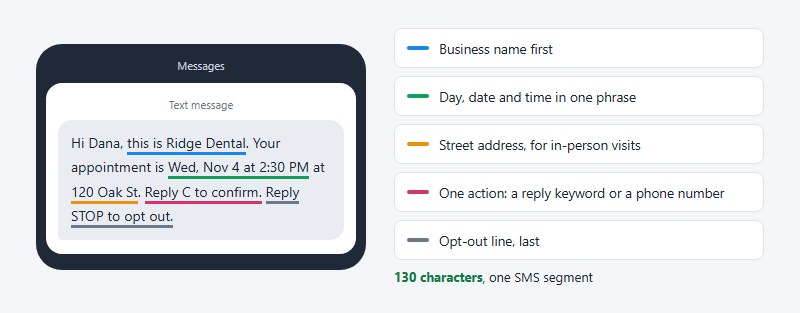
- Business name first, so the recipient knows who is texting.
- Day, date and time in one phrase (Wed, Nov 4 at 2:30 PM).
- The street address, when the visit is in person.
- One action, either a reply keyword or a phone number.
- The opt-out line, last.
Put together, it reads: “Hi Dana, this is Ridge Dental. Your appointment is Wed, Nov 4 at 2:30 PM at 120 Oak St. Reply C to confirm. Reply STOP to opt out.”
That’s 130 characters and one segment. Every sample below gets its count the same way.
Merge fields and fallbacks
Merge fields pull values from the booking record into the template. Most reminders get by with the first name, the provider or staff name, the service type, and a location name if the business has more than one site.
Set a fallback for each one. A blank first name turns “Hi Dana,” into “Hi ,”, so drop the greeting entirely when the field is empty.
Service type needs a bit more care. A label like “root canal” says more than a reminder needs, so use “visit” or “appointment” for anything medical.
Keeping the text inside one segment
According to Twilio’s documentation, one segment holds 160 characters in the GSM-7 alphabet and 70 in UCS-2. Once a message splits, each piece carries fewer characters because it reserves space for a reassembly header.
| Encoding | One message | Per segment when split |
|---|---|---|
| GSM-7 | 160 | 153 |
| UCS-2 | 70 | 67 |
A single character outside GSM-7 flips the whole message to UCS-2. Emoji do it. Curly quotes do it too, and those are the annoying ones, since a text editor often swaps them in without telling you.
The 130-character sample above, with one checkmark emoji added, becomes a two-segment message. Twilio bills per segment sent. I’d skip emoji in reminders altogether.
Twilio’s Smart Encoding swaps certain non-GSM characters for GSM equivalents, such as curly quotes for straight ones (as of October 2026). An emoji has no equivalent.
The FCC’s 2015 declaratory ruling (FCC 15-72) sets the same 160-character limit for healthcare texts that rely on its consent exemption.
Free Appointment Reminder Text Generator
Appointment reminder text examples by industry
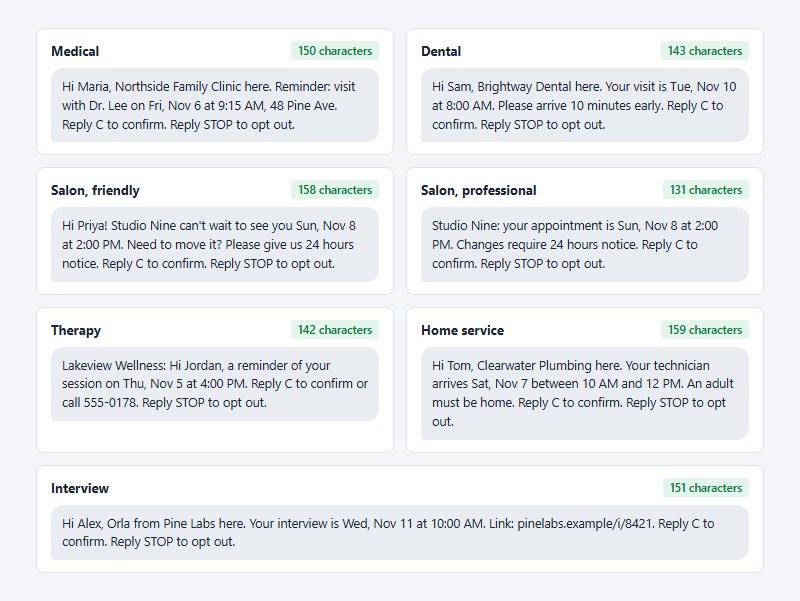
Each industry keeps the same five fields and changes a detail or two. Dental offices add an arrival buffer, and home service companies add an arrival window.
Medical and dental
“Hi Maria, Northside Family Clinic here. Reminder: visit with Dr. Lee on Fri, Nov 6 at 9:15 AM, 48 Pine Ave. Reply C to confirm. Reply STOP to opt out.” (150 characters)
A dental office might send this one instead. “Hi Sam, Brightway Dental here. Your visit is Tue, Nov 10 at 8:00 AM. Please arrive 10 minutes early. Reply C to confirm. Reply STOP to opt out.” (143 characters)
Write “visit” and leave out the procedure or diagnosis. Name the provider if the patient sees more than one, and add an arrival buffer when paperwork waits at the front desk.
The reason for the visit stays out because HIPAA’s minimum necessary standard limits a text to what the reminder needs.
Salon and beauty
Friendly tone first. “Hi Priya! Studio Nine can’t wait to see you Sun, Nov 8 at 2:00 PM. Need to move it? Please give us 24 hours notice. Reply C to confirm. Reply STOP to opt out.” (158 characters)
The professional version drops the exclamation mark and runs shorter. “Studio Nine: your appointment is Sun, Nov 8 at 2:00 PM. Changes require 24 hours notice. Reply C to confirm. Reply STOP to opt out.” (131 characters)
The friendly version sits two characters under the limit. Add an emoji and it splits, so settle the tone before adding anything.
If a late-cancel fee applies, put the cancellation window in the text. One line there does more than a policy page buried on a website.
Therapy and counseling
Neutral wording matters most here, because a lock-screen preview shows the first line to anyone nearby.
“Lakeview Wellness: Hi Jordan, a reminder of your session on Thu, Nov 5 at 4:00 PM. Reply C to confirm or call 555-0178. Reply STOP to opt out.” (142 characters)
The sender name says “Wellness” and the body says “session”. Neither names a specialty or a provider.
Home service
“Hi Tom, Clearwater Plumbing here. Your technician arrives Sat, Nov 7 between 10 AM and 12 PM. An adult must be home. Reply C to confirm. Reply STOP to opt out.” (159 characters)
Give a two-hour arrival range instead of a single time, and say who has to be home or where the key is. A dispatcher number only helps if someone answers it, and this sample has no room left for one anyway.
Interviews and business meetings
Remote meetings need the link in the text itself, so nobody digs through an inbox at 9:58.
“Hi Alex, Orla from Pine Labs here. Your interview is Wed, Nov 11 at 10:00 AM. Link: pinelabs.example/i/8421. Reply C to confirm. Reply STOP to opt out.” (151 characters)
Add the time zone when the other person is remote. Even this 23-character link takes about 14 percent of the segment, so keep it short.
When should each reminder text go out?
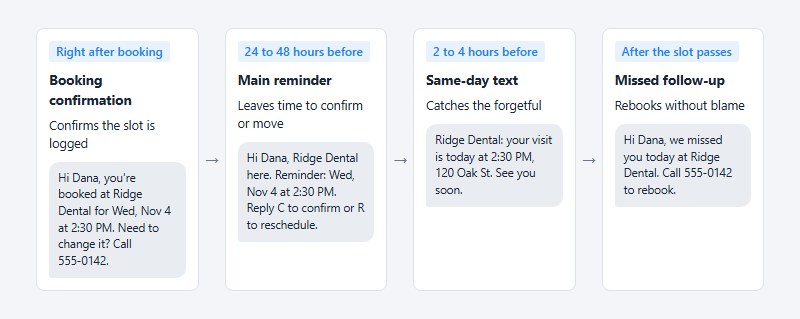
Most setups need a confirmation at booking and a main reminder 24 to 48 hours before the visit. Add a same-day text 2 to 4 hours out if no-shows are a problem, and a follow-up for anyone who misses.
| Stage | Timing | Job |
|---|---|---|
| Booking confirmation | Right after booking | Confirms the slot is logged |
| Main reminder | 24 to 48 hours before | Leaves time to confirm or move |
| Same-day text | 2 to 4 hours before | Catches the forgetful |
| Missed follow-up | Same day, after the slot passes | Rebooks without blame |
A confirmation text sent at the moment of booking tells the client the slot is real. It also fixes the number that later reminders come from.
What the studies say about timing
Kaiser Permanente Washington randomized a second text for high no-show risk visits in 2019, comparing one text reminder against two. The extra text cut the chance of a no-show by 7% in primary care and 11% in mental health visits.
The Buenos Aires result looks different. A 2026 medRxiv preprint from the city’s public health system compared WhatsApp reminders sent at about 72 hours, about 24 hours, both, or not at all. One reminder near 24 hours did as well as the two-reminder schedule and beat the 72-hour reminder alone. It was observational, and it used WhatsApp rather than SMS.
Part of the gap is population. Kaiser tested only visits flagged as high risk, while the Buenos Aires comparison covered ordinary outpatient visits across 15 specialties.
My rule of thumb is one reminder at 24 to 48 hours for routine visits, and a second text only for patients with a no-show history.
Vendor guides split on the main reminder (Updox says three days out, Curogram 48 hours). The same-day text is vendor advice too (Curogram suggests 2 to 4 hours before), and neither study tested it.
Templates for each stage
The booking confirmation goes out first. “Hi Dana, you’re booked at Ridge Dental for Wed, Nov 4 at 2:30 PM. Need to change it? Call 555-0142. Reply STOP to opt out.” (122 characters)
Two days out, the reminder offers a reschedule option too. “Hi Dana, Ridge Dental here. Reminder: Wed, Nov 4 at 2:30 PM. Reply C to confirm or R to reschedule. Reply STOP to opt out.” (122 characters)
The next-day version drops the reschedule option and adds the street address. “Hi Dana, see you tomorrow at 2:30 PM at Ridge Dental, 120 Oak St. Reply C to confirm. Reply STOP to opt out.” (108 characters)
On the day itself it gets shorter. “Ridge Dental: your visit is today at 2:30 PM, 120 Oak St. See you soon. Reply STOP to opt out.” (94 characters)
And if the person doesn’t show, keep the follow-up free of blame. “Hi Dana, we missed you today at Ridge Dental. Call 555-0142 to rebook. Reply STOP to opt out.” (93 characters)
Count the sequence before launching it. Healthcare senders relying on the FCC exemption get one text per day and three per week per provider (FCC 15-72), so four texts in a week is one too many, and a same-day reminder plus a same-day missed-visit follow-up is two in one day.
How do confirm, reschedule and cancel replies work?
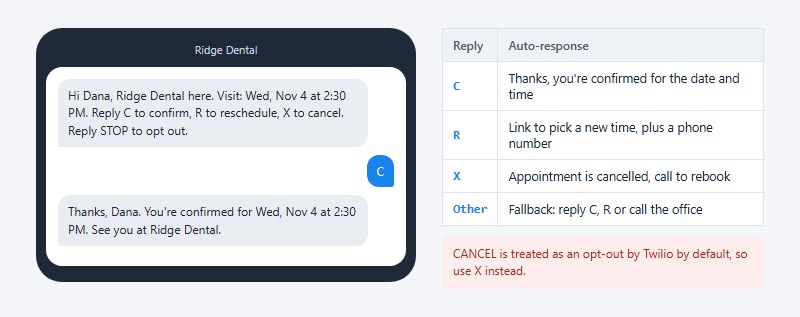
The recipient replies with a single keyword, usually C or YES, and the system maps it to an action, like marking the booking confirmed or releasing the slot on a cancel. The reminder has to list the keywords, since nobody guesses them.
One prompt can carry all of them. “Hi Dana, Ridge Dental here. Visit: Wed, Nov 4 at 2:30 PM. Reply C to confirm, R to reschedule, X to cancel. Reply STOP to opt out.” (130 characters)
Reply keywords and auto-responses
A C reply gets a short thank-you. “Thanks, Dana. You’re confirmed for Wed, Nov 4 at 2:30 PM. See you at Ridge Dental.” (82 characters)
R sends a link and a phone number. “No problem. Pick a new time at ridgedental.example/r/8421 or call 555-0142.” (75 characters)
X cancels and says so plainly. “Done. Your Wed, Nov 4 appointment is cancelled. Call 555-0142 to rebook.” (72 characters)
Anything else falls through to a fallback. “Sorry, we didn’t catch that. Reply C to confirm, R to reschedule, or call 555-0142.” (83 characters)
Avoid CANCEL as the cancel keyword. As of October 2026, Twilio treats CANCEL, along with STOP, STOPALL, UNSUBSCRIBE, END, QUIT, REVOKE and OPTOUT, as an opt-out by default, so a patient who texts CANCEL to drop one appointment is unsubscribed from everything.
The filter matches the single word only. “Please cancel” passes through to your own handler, which is why the fallback reply above earns its place.
What a silent recipient tells you
In a University of Kentucky pilot (2016), 39% of 577 appointments drew a C reply to confirm and 61% stayed silent. Of the confirmed appointments, 82% were attended.
Among the silent ones, 58% were attended anyway. Silence is a weak no-show signal (one clinic, three weeks, so read it as a pattern, not a benchmark), which is a reason not to auto-cancel unconfirmed bookings.
Use the missing reply to flag who gets a call instead. A cancel reply two days out gives the front desk time to refill the slot, and how you handle cancelled appointments decides how much of that revenue comes back.
Keyword, link or phone number?
| Option | Strength | Weakness |
|---|---|---|
| Keyword reply | One tap, status updates itself | Needs a two-way number and reply parsing |
| Reschedule link | Lets the person pick a new time | Costs characters, needs a booking page |
| Call-back number | Works with any setup | Staff time on every change |
Keywords win for confirmation since a one-letter answer beats phone tag. Rescheduling is different. Picking a new time is too much to ask of a keyword, so a link works better there.
What do TCPA, HIPAA and carrier rules mean for the wording?
Consent and opt-outs fall under the TCPA, while HIPAA limits what a health-related text can reveal. Carriers get the last word, because they decide whether the message is delivered at all.
Consent under the TCPA
For healthcare senders, the FCC’s 2015 ruling (FCC 15-72) treats a phone number given to a provider as prior express consent for healthcare calls and texts. The exemption stops at marketing, billing and other financial content, so a reminder that adds a discount or a balance due falls outside it.
Everyone else can’t lean on the healthcare exemption. Scheduling vendors such as Apptoto read a wireless number given at booking as express consent for non-marketing reminders, and still tell businesses to keep proof of how that consent was obtained.
In Latner v. Mount Sinai Health System (2018), the Second Circuit ruled for the hospital over a flu shot reminder text and held that the text fell within the prior express consent the patient had given. The patient had signed the hospital’s consent form.
The exemption also requires the text to be free to the recipient and outside any plan limit. Law-firm alerts flag that condition as hard to verify, which is one reason vendors recommend documented consent even for healthcare reminders.
Opt-out wording and the revocation rules
| Rule | Requirement | Status (October 2026) |
|---|---|---|
| Revocation words | Stop, quit, end, revoke, opt out, cancel and unsubscribe count as revocation; honor within 10 business days | In effect since April 11, 2025 |
| Healthcare exemption | Honor an opt-out immediately | In effect since the 2015 ruling |
| Revoke-all provision | One revocation covers all robotexts from that sender | Delayed to January 31, 2027 |
Status follows the FCC’s January 6, 2026 order, as summarized by Burr & Forman.
The 10-business-day clock is the general limit. A sender relying on the healthcare exemption has no clock, so process STOP replies in real time, not in a nightly batch.
CANCEL sits on the FCC’s list too. A patient who replies CANCEL has revoked consent in law, not only in a carrier filter.
HIPAA and the body of the text
Appointment reminders count as treatment under HIPAA, so no patient authorization is needed (HHS, FAQ 286).
Sources split on how much the body can say. HHS lists disclosures to the individual and for treatment among the exceptions to the minimum necessary standard, so the standard does not formally bind a reminder text.
Compliance vendors apply it anyway, and the FCC’s healthcare exemption requires the message to comply with HIPAA privacy rules. Write to the stricter reading, since the text sits on a phone anyone nearby can pick up.
Provider name, date, time and location are fine. Diagnosis, procedure name, test results and balance due stay out.
Carrier registration for business texting
- Register a brand, which tells carriers who is sending (standard brands also need a Tax ID).
- Register a campaign with the message purpose, plus how recipients opt in, opt out and get help.
- Add each 10DLC number to a Messaging Service tied to the approved campaign.
Per Twilio’s documentation (as of October 2026), unregistered 10DLC numbers have been blocked from sending to US numbers since September 1, 2023. Blocked messages return error 30034, and Twilio still bills for them.
The Campaign Registry (TCR) checks each campaign against CTIA’s Messaging Principles and Best Practices, which carriers made mandatory for A2P traffic after the 2023 update (Holland & Knight, May 2026). A rejection means revisions and re-registration, which adds weeks.
Do appointment reminder texts reduce no-shows?
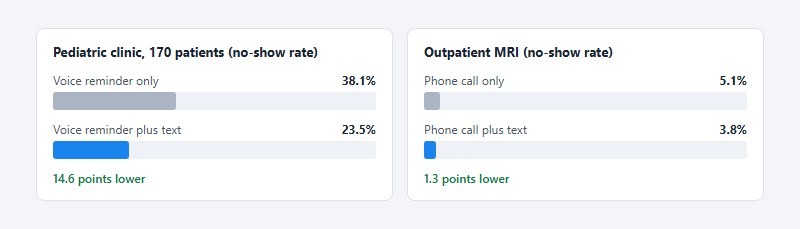
Yes. Trials show text reminders raise attendance, and the gain is largest where no-shows run high.
Across seven studies and 5,841 participants, attendance rose 14% in relative terms with text reminders versus none (RR 1.14, 95% CI 1.03 to 1.26), according to a Cochrane review (2013).
A 170-patient randomized trial found no-shows fell from 38.1% to 23.5% when a pediatric clinic added a text to its voice reminder (International Journal of Pediatrics, 2016). Massachusetts General Hospital saw outpatient MRI no-shows drop from 5.1% to 3.8% after adding a text to its phone call (Journal of the American College of Radiology).
On cost, a text reminder came in 55% and 65% cheaper per attended appointment than a phone reminder in two studies (Cochrane review, 2013).
Calculated from the reported rates, the added text cut no-shows by about 38% of their baseline in the pediatric trial (14.6 points) and about 25% in the MRI study (1.3 points).
The payoff tracks the starting miss rate. A practice at 5% no-shows gains little in absolute terms, and one at 35% gains a lot.
Replacing calls with texts is a separate question. Cochrane found a similar attendance effect for both channels at lower cost, while the pediatric and MRI studies tested texts added on top of calls.
Cochrane rates the evidence low to moderate quality, and the included studies were heterogeneous. Read the figures as direction, not a forecast.
Scheduling tools that send reminder texts automatically
Amelia, Acuity Scheduling, Square Appointments, Calendly and SimplePractice all send reminder texts out of the box. They differ on customization and on reply handling, and Twilio covers the custom cases for a per-segment fee.
| Tool | Text reminders | Replies | Limit to watch |
|---|---|---|---|
| Amelia | SMS, email and WhatsApp notifications sent from the booking; WhatsApp on higher-tier plans; custom notifications with your own timing | Not documented on wpamelia.com | SMS runs on a prepaid balance billed per segment; unavailable in some countries |
| Acuity Scheduling | Standard/Growing and Premium/Powerhouse plans; editable after business verification | Automated reply only | One text per appointment, 300 characters |
| Square Appointments | Plus and Premium plans; custom text with variables | Not documented; manual mark-as-confirmed | Transactional only, 1,024-character cap |
| Calendly | Workflows on paid plans, not during the trial | Not delivered to you | 180 characters, 100 invitees per event |
| SimplePractice | Editable template with clinician and practice fields | Confirm or cancel by link; free-text replies unmonitored | 500 characters, no-reply number |
| Twilio | API, any template you write | Two-way, handled by your code | $0.0083 per segment plus carrier fee |
Figures come from each vendor’s help center and Twilio’s pricing page, as of October 2026. Amelia details come from wpamelia.com.
What the built-in options leave out
Acuity allows one text per appointment, so a staged sequence needs another sender.
Keyword replies are the next gap. Calendly does not deliver replies and Acuity answers with a canned message, so a “Reply C” prompt needs a two-way sender.
Links work better. SimplePractice carries confirm and cancel links, and Calendly adds reschedule and cancel links through its invitee variable.
That’s the gap appointment reminder apps try to fill. Whichever one you look at, check reply handling, texts per booking, the character cap and registration.
On a WordPress site, Amelia sends SMS, email and WhatsApp notifications from the booking itself, so the reminder text and the booking record live in one place. You set each template once (message, channel and timing) and choose whether it goes to customers, employees or both.
SMS needs an Amelia SMS account with a recharged balance, and prices apply per message segment. Since September 30, 2024, SMS providers also charge for failed deliveries. Amelia is rated 4.6 on WordPress.org and has more than 90,000 customers.
For a business that is not on WordPress, Trafft is a hosted booking tool from the same team that sends automated reminders, with SMS credits bought separately.
Where appointment reminder texts fail
Texts don’t reach everyone, and they don’t fix everything.
Only 67.5% (2,083 of 3,086) of the Massachusetts General texting group could be reached by text. The rest needed another channel.
Numbers also get reassigned. A permanently disconnected number waits 45 days before reassignment (FCC Reassigned Numbers Database, adopted December 2018), and the safe harbor covers only a sender who relied in good faith on a wrong database result.
Opt-outs travel too. On Acuity, a client who replies STOP is opted out of reminders from every Acuity business, so a client can go silent without ever opting out of yours.
And texts don’t make people punctual. The MRI study found they cut no-shows but did not move arrival times, even with a request to come 30 minutes early.
Keep a phone or mail fallback for the unreachable third of a list. And check long-lived contact lists against the reassigned numbers database before each campaign.
Appointment Reminder Text FAQ
Should reminders go by text, email, or phone call?
Text is the best default for the reminder itself. People who cannot receive texts need a call, and email handles preparation details that will not fit in 160 characters.
Keep the text to the date, time, and reply option. Push the long instructions to email.
What is the best time of day to send a reminder text?
Send during the recipient’s local daytime hours and skip early morning and late evening.
The trials cited in this article tested how many days before the visit the text went out, not the clock time, so distance from the appointment is the bigger lever.
Can reminders come from a personal phone number?
Not for automated ones. Twilio’s documentation says a platform sending from a number not tied to an approved A2P 10DLC campaign gets blocked with error 30034.
Register a brand and campaign, or send from a sender type outside 10DLC, such as a toll-free number or short code.
Is it safe to use a link shortener like bit.ly in a reminder text?
No. Calendly’s help center warns that some carriers block URL shorteners such as bit.ly.
Use a short link on your own domain instead, like the 23-character one in the interview sample.
Should a reminder text mention message and data rates?
Say it once, at consent. Acuity recommends telling clients that carrier rates apply, and Twilio’s default opt-in confirmation carries the line “Msg&Data Rates May Apply”.
Repeating it in every reminder spends characters the appointment details need.
Measuring Whether Your Reminder Texts Cut No-Shows
Compare no-show rates on matching weekdays before and after launch, and make sure the sample is big enough for the difference to mean something.
Sample size sets the wait. Calculated from the pediatric and MRI rates (80% power, two-sided 0.05), confirming a drop from a 38.1% baseline takes about 156 appointments per group, while confirming the 1.3-point drop from 5.1% takes about 3,950.
Record the baseline no-show rate first, since a rate recorded after launch has nothing to be compared against. Launch one change at a time, and track STOP replies next to no-shows. Amelia has a no-show tag on bookings, which makes the count easier to pull later.
Opt-outs earn a column from day one. If the FCC lets its revoke-all rule take effect on January 31, 2027, a STOP reply to a reminder will end every robotext from that sender (position verified October 30, 2026).

Explore topics

Read Inspiring Customer Stories
Check out how our user set Amelia for his business