



Most service businesses don’t lose bookings because clients aren’t interested. They lose them at the payment step, where a moment of friction is enough to make someone close the tab.
A PayPal booking system takes that friction out by pairing online appointment scheduling with a payment gateway clients already know and trust.
PayPal has 434 million active accounts globally. That kind of brand recognition cuts checkout hesitation in a way lesser-known processors just can’t, and the rest of this gets into how it actually works: how PayPal connects to booking platforms, which tools support it natively, what it really costs, where it falls short against Stripe, and how to handle deposits, refunds, and recurring payments.
What Is a PayPal Booking System?
It’s a scheduling or reservation platform that uses PayPal as the payment processor to collect deposits or full payments at the moment of booking.
PayPal doesn’t make a native booking product. It works as the payment layer inside third-party booking software, handling the financial transaction while the scheduling platform runs the calendars, availability, and confirmation logic.
Think of it as two separate products working together. The booking platform owns the customer-facing scheduling experience. PayPal owns the checkout.
What Are the Core Components of a PayPal Booking System?
Every functional PayPal booking setup comes down to three pieces. There’s the scheduling interface, the front-end page where clients pick a date, time, and service. There’s the calendar availability engine, the backend logic that manages open slots, blocks time, and stops double bookings. And there’s the PayPal payment gateway connection, the API bridge that handles transaction authorization, deposit collection, and the booking confirmation triggers.
The online booking software market was worth $2.5 billion in 2024, growing at a 12.4% CAGR through 2032 (Verified Market Research, 2024). Small and medium-sized businesses make up roughly 60% of it.
What Types of Businesses Use a PayPal Booking System?
61% of bookings are now made online globally, with 47% of users preferring instant mobile-based reservations (Business Research Insights, 2024).
A few categories reach for a PayPal-connected setup more than the rest. Service businesses, the consultants, personal trainers, therapists, and hair salons running single-provider, appointment-based work.
Rental businesses, where equipment hire, vacation rentals, and vehicle rental run on time-block reservations with upfront deposits. Event-based businesses like fitness classes, workshops, and tours, juggling multi-seat capacity with pre-payment. And online service providers, the coaches, tutors, and freelance consultants scheduling virtual appointments with PayPal checkout.
Each category has different booking logic underneath. A consultant scheduling setup handles single-slot, one-person sessions. A class-based business manages capacity limits across multiple seats per session. Both can use PayPal, but the platform layer differs significantly.
A beauty salon booking website typically needs staff assignment, service duration management, and deposit collection at checkout. A barber shop has similar requirements. These are exactly the use cases where a PayPal booking system performs well out of the box.
How Does PayPal Integration Work in a Booking System?
PayPal connects to a booking platform one of two ways: through the PayPal REST API or the PayPal Checkout SDK. The REST API gives developers full control over the transaction flow. The SDK provides pre-built payment buttons that booking platforms embed without any custom code.
The standard booking-to-payment flow runs in five steps. The customer selects a time slot, enters their details, moves to the payment screen, completes payment through PayPal Checkout or an embedded PayPal button, and receives a booking confirmation email triggered by the payment success event.
How Does Payment Confirmation Trigger Booking Confirmation?
This is where most of the technical work happens. Booking platforms listen for a PayPal IPN (Instant Payment Notification) or a webhook event to confirm the payment cleared before they lock the reservation.
Without that webhook confirmation, a booking could look confirmed on the client’s end while the payment is still pending. Most professional booking tools handle this automatically once PayPal is connected through OAuth credentials from the PayPal Developer Dashboard.
Both deposit and full-payment setups are supported. Deposit configurations collect a partial amount at booking and take the balance at the time of service. PayPal handles the partial capture through its Orders API, though not every booking platform exposes that option in its UI.
PayPal REST API vs. Checkout SDK in Booking Platforms
| Method | Best for | Setup complexity | Customization |
|---|---|---|---|
| PayPal REST API | Custom-built or developer-led booking tools | High (requires coding) | Full control over flow |
| PayPal Checkout SDK | Third-party platforms (Acuity, Bookly, SimplyBook.me) | Low (platform handles it) | Limited to platform UI |
| PayPal Sandbox | Testing before going live | Low | Mirrors live environment |
For most service businesses on an off-the-shelf booking platform, the Checkout SDK is the only integration they’ll ever touch. The REST API matters when you’re building a custom booking flow or adding logic the platform doesn’t natively support.
What Are the Best Booking Systems That Support PayPal?
Dozens of platforms support PayPal, but the depth of that integration varies a lot. Some offer native PayPal connections with deposit logic, refund automation, and webhook confirmation. Others limit PayPal to a basic redirect-and-pay flow.
Booking Platforms With Native PayPal Integration
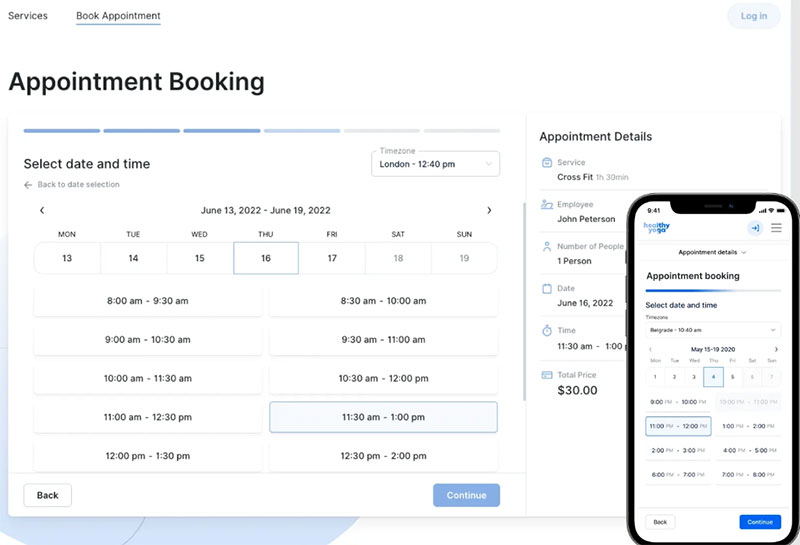
Trafft is a standalone scheduling platform (with a WordPress plugin available separately) that supports PayPal natively alongside Stripe, Square, Mollie, and Authorize.net. PayPal sits there as a one-click payment option at the moment of booking.
Trafft also supports deposit payments with fixed or variable amounts, automatic invoice delivery, and a transaction dashboard that tracks payment status per appointment, customer, and employee.
One thing worth noting: Mollie on Trafft is limited to Euro transactions, but PayPal has no such restriction. It works well for service businesses that operate outside WordPress and want a hosted solution with full payment visibility.
Acuity Scheduling connects directly to PayPal across all three of its paid plans (Starter, Standard, Premium). It supports full payments, partial deposits, tipping, and automatic receipt emails. As of April 2026, new PayPal connections in Acuity show a pop-up payment window right on the scheduler rather than redirecting clients to PayPal’s domain (Acuity Help Center, 2026), which cuts checkout friction significantly.
SimplyBook.me includes PayPal as one of 15+ supported payment providers, with support for PayPal invoicing alongside standard checkout. It’s a good option for businesses that also use PayPal for manual invoice-based billing outside the booking system.
Checkfront targets rental operators and tour companies specifically. Its PayPal integration supports partial payments and deposit configurations, which suits vacation rentals and equipment hire where upfront deposits are standard practice.
Setmore includes PayPal payment links on its free plan, though the confirmation is manual rather than webhook-triggered. That’s functional for low-volume businesses that can live with a manual step in the booking confirmation flow. If you’re comparing alternatives, a detailed breakdown of the best WordPress booking plugins shows how Setmore stacks up against the paid options.
WordPress-Specific PayPal Booking Plugins
WordPress users have two main routes: a dedicated booking plugin with PayPal built in, or WooCommerce paired with a bookings extension.
Amelia is a WordPress booking plugin with built-in PayPal support across all paid plans. It handles full payments, deposit payments, and automatic refunds when clients cancel. The PayPal integration runs alongside Stripe, Mollie, Square, WooCommerce, RazorPay, and Barion, so you’re not locked into a single gateway.
Deposit payments are especially flexible. You can set a fixed or percentage-based amount per service, and customers can pay the remaining balance on-site or through a secure payment link sent by email.
Amelia also auto-generates invoices with tax support, which makes it a good fit for WordPress-based businesses that want PayPal as part of a broader, multi-gateway payment setup.
WooCommerce Bookings + WooCommerce PayPal Payments builds a full e-commerce booking stack. This combination gives you the most control over product pages, pricing rules, and checkout logic, but it takes more configuration than a standalone booking plugin. It’s the right approach when booking is one part of a broader product catalog rather than the whole point of the site.
A proper WordPress booking system with payment gateway support should handle deposit collection, send confirmation emails automatically, and block the calendar slot the moment payment clears. Not every plugin does all three cleanly.
The Best PayPal Booking System: Amelia
Amelia is the best PayPal booking system because you can connect PayPal to your appointment scheduling system for all of your clients. Using Amelia, you can be assured that your clients will pay for their appointments before you meet in person.
The PayPal booking system integrated with Amelia streamlines online payments, making it easy for you to accept money with minimal hassle. Clients can choose their preferred payment method, ensuring a smooth transaction process.
Amelia offers a user-friendly interface that simplifies the booking and payment process for your services. It allows you to manage and accept payments automatically, reducing the need for customer interaction if you prefer a hands-off approach. Plus, you can also process partial payments and refunds with this powerful integration.
What is Amelia?
Curious about Amelia? Here’s why you should pay attention to this booking system.
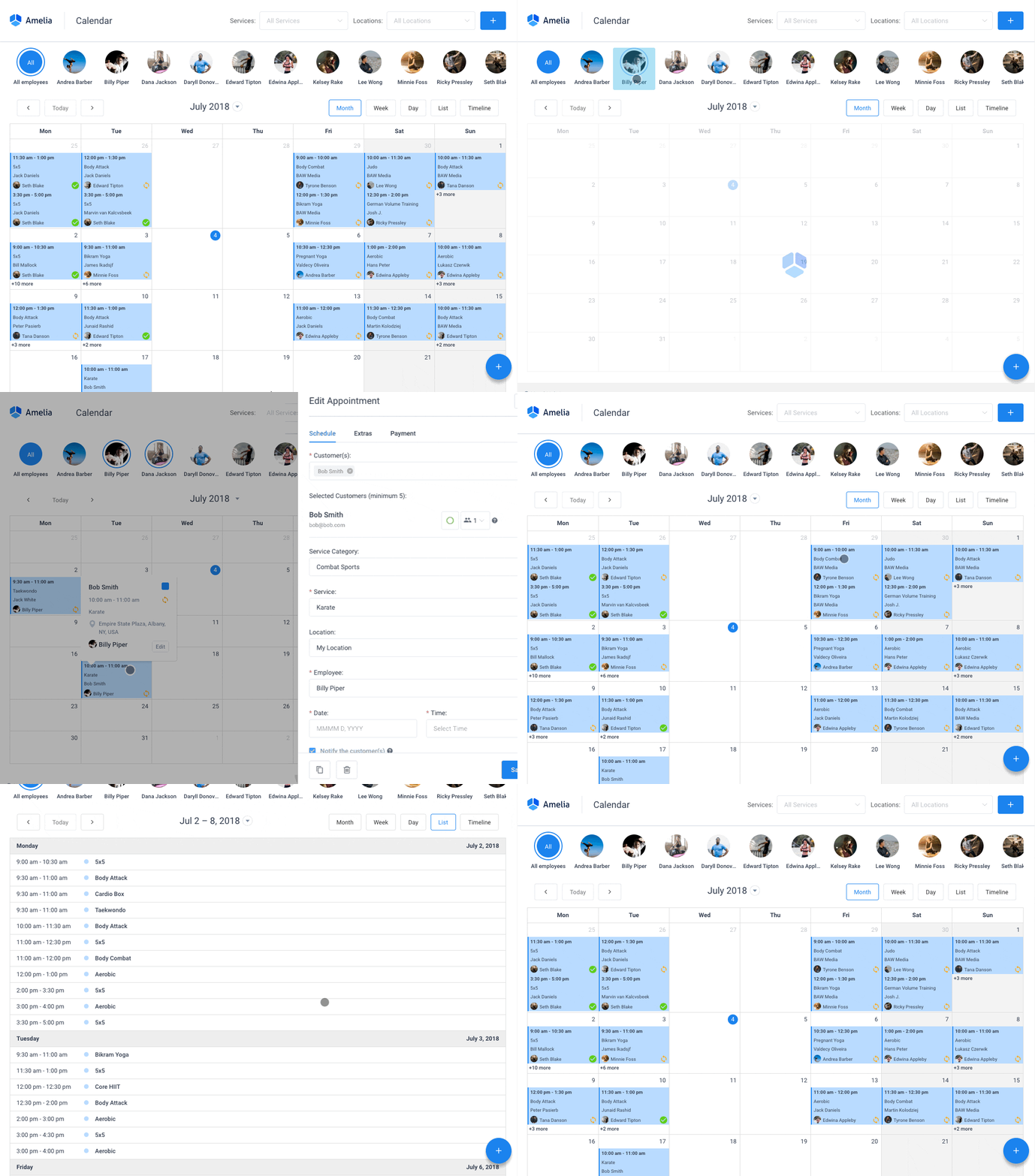
Amelia is a powerful WordPress booking plugin that works flawlessly with WordPress sites of all kinds. It has a minimal, yet powerful appointment booking interface designed to ease your workflow, automate repetitive tasks, avoid double booking, and make appointment booking a breeze for your customers.
You can even have email notifications and SMS notifications so that nobody forgets about their appointment bookings.
In order to book an appointment, the complete user interaction takes a few clicks with this WordPress plugin. Moreover, with it you can accept payments via PayPal and Stripe, perfect for those who want to pay in advance to book appointments.
As a business owner, you can monitor KPIs in the WordPress dashboard and analyze other important data to keep a pulse on your business. Amelia is a straightforward, no-nonsense booking calendar plugin and an amazing option for those who want an around-the-clock solution for their WordPress site.
Amelia also has an Events Calendar module integrated within its features.
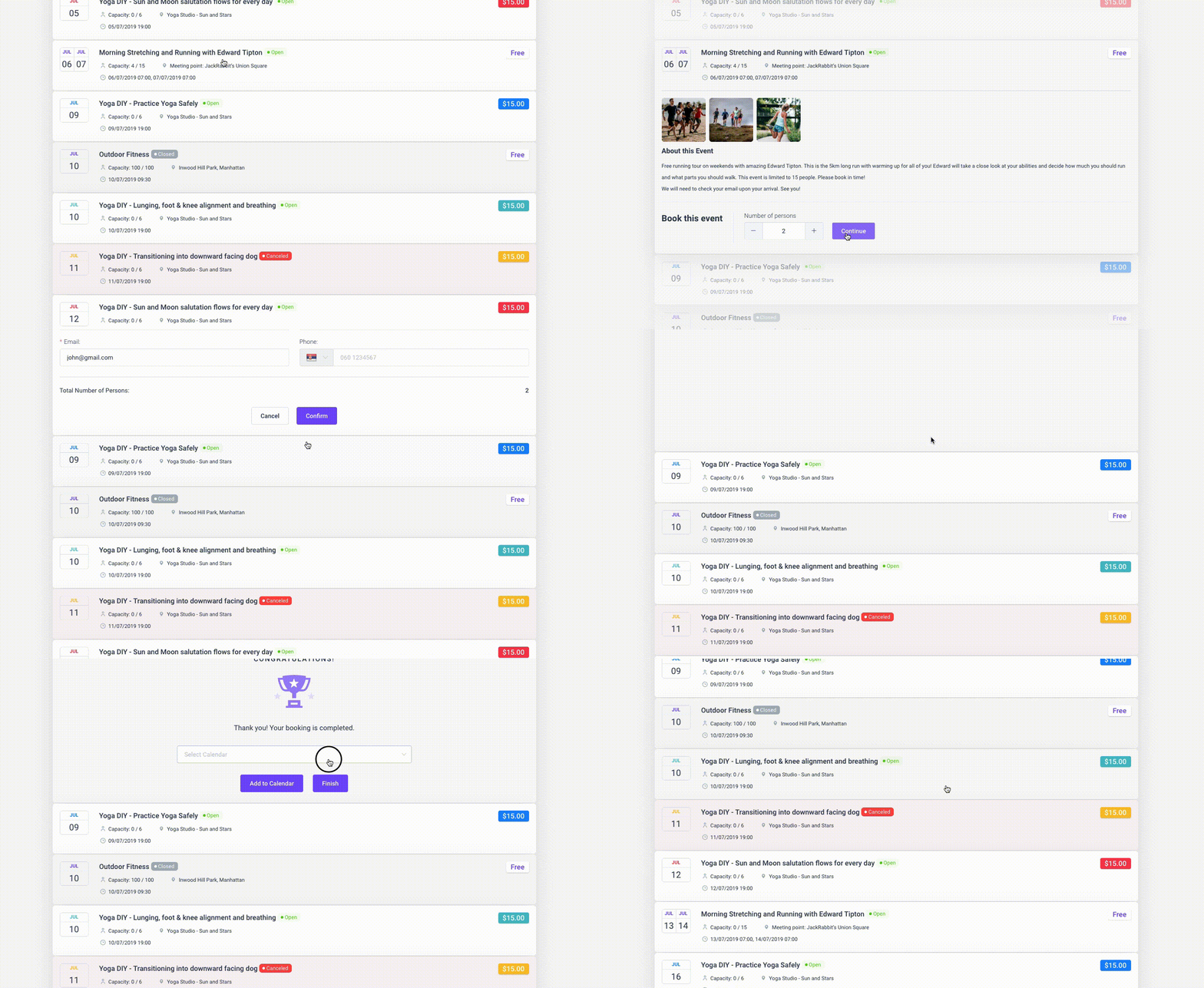
You can now automate your event bookings as well. To be more precise, it means that you will be able to schedule a single day, a multi-day, and also recurring events with Amelia.
Did we mention that you can manage multiple locations and that you have Google Calendar integration?
All of these and much more are under only one license, no add-ons are needed.
To test things for yourself, I’d suggest checking out the demos and seeing how things look on the front end as well as in the back end.
PayPal Booking System Examples
Wanna see Amelia and PayPal in action? We’ve got you covered with both frontend and backend demos!
Medical/Health online booking page demo

A website of a demo private clinic, where a visitor can read about provided medical procedures and services, and schedule an appointment.
→ View Frontend Demo – Backend demo
Barbershop booking page demo
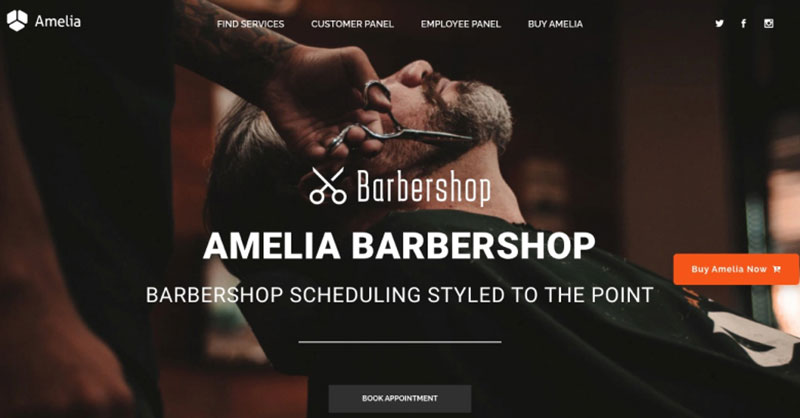
A dummy WordPress website for Barbershops with online booking – a nice and easy implementation with the Bridge theme and the Amelia WordPress booking plugin.
→ View Frontend Demo – Backend demo
Fitness Gym / Yoga booking page demo
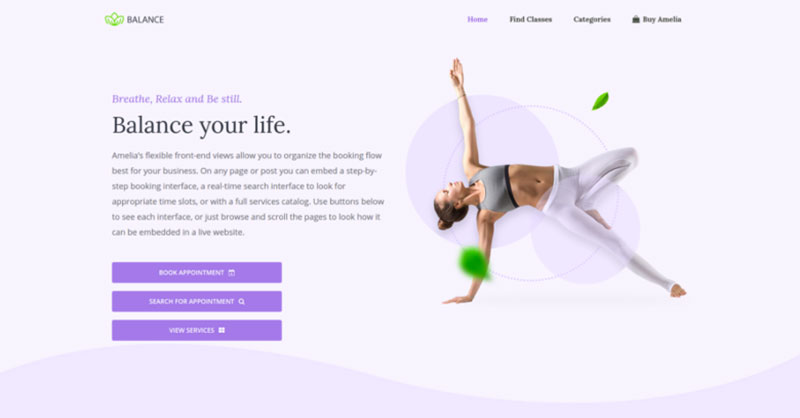
A pseudo Yoga/Gym online booking page where you can browse through possible Yoga classes, schedule individual or group training, and book a package of appointments.
→ View Frontend Demo – Backend demo
Spa/salon booking page demo

A dummy cosmetology website – look through different cosmetic procedures and treatments, pick an employee and schedule appointments.
→ View Frontend Demo – Backend demo
Consultant booking page demo

A pseudo Business Consultant / Coach / Lawyer website, where a customer can browse through provided consultancy and lawyer services and book an appointment.
→ View Frontend Demo – Backend demo
How to Set Up PayPal Booking System & Amelia?
Using the payment settings in Amelia, you can customize the pricing format and select payment gateways for your site. The chosen format applies to all prices displayed on both the front-end and back-end of the plugin.
This feature lets your customers pay directly with PayPal using their credit card, debit card, or PayPal balance. To get started, activate the PayPal Service option. You can then choose between Live Mode and Sandbox Mode.
For Live Mode, you’ll need to:
- Copy the Live Secret and Live Client ID from your PayPal account.
- Paste these into Amelia by navigating to Settings > Payments > PayPal.
If you’d rather test the payment environment first, use PayPal Sandbox Mode. It’s designed for testing, not for full business use. To set up Sandbox Mode:
- Visit PayPal Developer
- Select Dashboard on the left side of the page, then go to My Apps & Credentials.
- Create a new app or use an existing one in the REST API apps area.
- Copy the Client ID and Secret into the Sandbox PayPal Payment Settings in Amelia, just like with Live Mode.
- Navigate to the Sandbox menu and select Accounts.
- Use the developer account email and password to test the payment system.
Once PayPal is enabled, you’ll see an option to set MetaData and Description. PayPal lets you set a description for each payment, so use this to tell customers what they’re signing up for on the payment screen. You can customize descriptions for different appointments or events as needed.
With PayPal integrated, managing bookings and appointment scheduling becomes effortless. You can also generate and export monthly reports to track how well the system is working. And if you’d rather not deal with reports, you can disable that feature.
What Are the Costs of Running a PayPal Booking System?
A PayPal booking system carries two cost layers: PayPal’s transaction fees and the booking platform’s subscription. Most businesses underestimate the combined total until they run the numbers on a full month of transactions.
PayPal Transaction Fees for Booking Payments
PayPal charges 3.49% + $0.49 per transaction for standard online payments through PayPal Checkout (PayPal merchant fee schedule, 2026). Standard card payments processed outside the PayPal Checkout flow cost 2.99% + $0.49 per transaction.
In-person payments via PayPal QR code cost 2.29% + $0.09 per transaction, which is lower than most alternatives, Square and Shopify included.
International transactions add a cross-border fee of 1.5% on top of the base rate. Businesses taking bookings from clients in other countries should fold that into their pricing.
Booking Platform Subscription Costs
| Platform | Starting price | PayPal included | Best for |
|---|---|---|---|
| Setmore | Free (limited) | Yes (manual confirmation) | Very low-volume bookings |
| Amelia (WordPress) | $49/yr | Yes (all paid plans) | WordPress service businesses |
| Acuity Scheduling | $20/mo | Yes (all plans) | Appointment-based businesses |
| SimplyBook.me | $9.90/mo | Yes (as add-on) | Multi-service providers |
| Checkfront | $49/mo | Yes | Rental and tour operators |
The real cost is transaction fees multiplied by booking volume, plus the monthly platform fee. A business processing 100 bookings a month at an $80 average transaction value pays roughly $279 in PayPal fees alone at the 3.49% + $0.49 rate. Add the platform subscription and you’re looking at $330 to $380 a month in payment infrastructure before anything else.
For businesses just getting started, pairing a free WordPress booking plugin with PayPal Checkout can drop the platform cost to zero while keeping transaction fees standard. That works well at low volume. At higher volume, a paid platform with better automation usually saves more time than it costs.
What Are the Limitations of Using PayPal in a Booking System?
PayPal works well for plenty of booking setups. But there are documented friction points that hit some business types harder than others, and they’re worth knowing before you build your whole payment flow around it.
PayPal Checkout Abandonment Rates
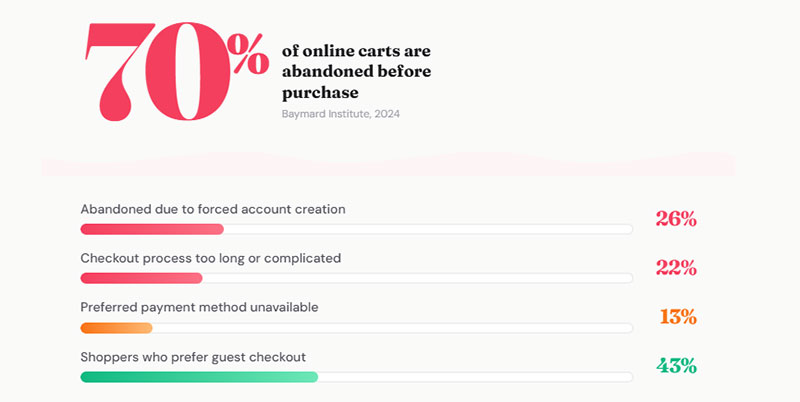
The global cart abandonment rate hit 70.19% in 2024 (Baymard Institute), and a sizeable slice of that traces back to account-required checkout flows.
26% of shoppers abandon their cart specifically because mandatory account creation gets in the way (Baymard Institute via PayPal, 2024). PayPal’s checkout historically required logging into a PayPal account. Guest checkout has improved this, and 43% of shoppers now say they favor guest checkout for online purchases (Drip, 2023).
For booking systems, abandonment at checkout means a lost appointment slot that may never get rebooked. A look at common appointment scheduling mistakes shows checkout friction as one of the top reasons clients fail to complete their booking.
Refund and Dispute Conflicts With Booking Cancellation Policies
PayPal’s buyer protection can override a booking platform’s no-refund terms. If a client files a dispute through PayPal’s Dispute Resolution Center, PayPal evaluates the claim on its own, independent of whatever cancellation policy the business published on its booking page.
To defend against chargebacks, businesses need to document three things: the booking confirmation emails, the client’s acknowledgment of the cancellation policy at checkout, and any communications after the booking was made. Most platforms generate the confirmation emails automatically. The policy acknowledgment at checkout is often an optional setting, but it should be switched on.
PayPal Fund Hold Policy for New Accounts
New PayPal sellers can have payments held for up to 21 days (PayPal, official help documentation). For a new service business launching with a PayPal booking system, that means the first several weeks of booking revenue may not be immediately accessible.
This is a genuine cash flow issue, not a minor inconvenience. Businesses that need immediate access to booking revenue should either set up their PayPal account well before launching the booking system, or consider a processor like Stripe that deposits funds in roughly 2 business days after the initial payout period.
How Does PayPal Compare to Stripe in a Booking System?
PayPal and Stripe are the two processors most commonly wired into booking platforms. They have similar base fees but very different approaches to developer flexibility, payout timing, and recurring billing.
Fee Comparison
Stripe’s base fee is 2.9% + $0.30 per transaction for standard card payments. PayPal’s standard PayPal Checkout fee is 3.49% + $0.49 per transaction for online payments (PayPal merchant fee schedule, 2026).
For low-ticket bookings, the fixed fee difference ($0.30 vs $0.49) matters more than the percentage gap. A $30 booking costs $1.17 in Stripe fees and $1.54 in PayPal Checkout fees. A $300 booking costs $9.00 in Stripe fees and $10.96 in PayPal Checkout fees. At high volume, that gap adds up.
Developer Flexibility and Recurring Billing
Stripe’s API is significantly more customizable than PayPal’s. Booking platforms built on Stripe can implement custom logic, dynamic pricing, and subscription billing with fewer constraints. PayPal’s Billing Agreements exist for recurring payments but are less straightforward to configure for session-based recurring bookings like weekly coaching or monthly retainers.
For small business scheduling software, this usually doesn’t matter, since the pre-built platforms handle the integration complexity. But if you’re building a custom booking tool or need recurring billing that charges clients automatically each week, Stripe handles that more cleanly.
Consumer Recognition and Trust
PayPal has 434 million active accounts globally (PayPal, end of 2024). That familiarity is a real conversion advantage in markets where PayPal is the default digital wallet. Clients who see a PayPal button at checkout already trust it, which takes the edge off any hesitation.
Stripe isn’t consumer-facing in the same way. Clients paying through Stripe see a generic card form or a branded checkout page, not the Stripe name. Stripe processes payments in more than 135 currencies. PayPal supports 25 currencies, which matters for booking businesses with international clientele.
| Factor | PayPal | Stripe |
|---|---|---|
| Standard checkout fee | 3.49% + $0.49 | 2.9% + $0.30 |
| Active accounts | 434 million (end 2024) | Not consumer-facing |
| Currency support | 25 currencies | 135+ currencies |
| Payout timing | ~3 business days | ~2 business days |
| Recurring billing | Billing Agreements (complex) | Native Subscriptions API |
| API customization | Moderate | Extensive |
The right choice between them comes down to who your clients are and how technically complex your booking flow needs to be. PayPal wins on brand recognition and ease of setup. Stripe wins on fee structure, recurring billing, and developer control. Platforms like Acuity Scheduling let you connect both at once, which sidesteps the choice entirely.
How to Set Up a PayPal Booking System Step by Step
Setup runs anywhere from 30 minutes to a few hours depending on the platform. The PayPal side is straightforward. Most of the configuration time goes into the booking platform itself.
Setting Up a PayPal Business Account for Bookings
Personal PayPal accounts can’t receive service payments in most regions, so a PayPal Business account is required. Setup is free and takes about 10 minutes.
After you create the account, a few things need verifying before you go live: identity verification (a government ID or SSN, depending on country), a linked bank account for withdrawals, and a confirmed business category, which affects which features and rates apply.
New accounts run into the 21-day payment hold mentioned earlier. Running a few low-value test transactions and building a short payment history before launching the full booking system helps clear that hold faster (PayPal, official documentation).
Connecting PayPal to Your Booking Platform
The connection process varies slightly across platforms but follows the same pattern. For most platforms using the PayPal Checkout SDK:
- Log into the PayPal Developer Dashboard and create an app to get the Client ID and Secret
- Go to your booking platform’s payment settings and select PayPal as the processor
- Paste the Client ID and Secret into the required fields
- Toggle between sandbox (testing) and live mode
- Configure the deposit amount, currency, and refund policy within the booking platform settings
Run three to five test bookings through the PayPal sandbox before you switch to live. Check that the booking confirmation email fires after payment, the calendar slot blocks correctly, and the refund flow works as expected. Those are the three failure points that most commonly cause problems in real transactions.
For WordPress-based setups, a WooCommerce appointments approach adds another configuration layer but gives more flexibility over product pages and pricing rules. If you’re building an appointment system on WordPress and plan to take online deposits through PayPal, that route is worth weighing against a standalone booking plugin.
Once the connection is live and tested, the booking system handles everything on its own. Clients book, pay via PayPal Checkout, get a confirmation email, and the calendar updates in real time. No manual steps on the business side unless a cancellation or refund needs processing.
What PayPal Features Directly Support Booking Workflows?
PayPal isn’t just a payment button. Several specific features within the PayPal Commerce Platform map directly to booking use cases, and most service businesses only ever use a fraction of what’s available.
PayPal Pay Later for High-Ticket Bookings
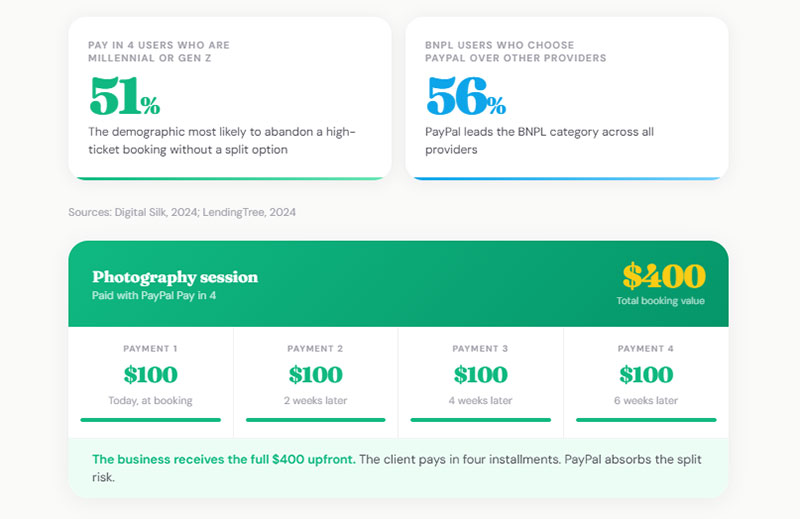
PayPal Pay Later (also called Pay in 4) lets clients split a booking payment into four interest-free installments. It’s especially relevant for higher-priced services where a single upfront payment makes people hesitate.
51% of Pay in 4 users are Millennials or Gen Z (Digital Silk, 2024). PayPal leads the BNPL category overall, used by 56% of BNPL users across all providers (LendingTree, 2024).
For a $400 photography session or a $600 multi-day tour, offering Pay Later at checkout can be the difference between a confirmed booking and an abandoned one. The business gets the full amount upfront. The client pays in installments. PayPal absorbs the split.
PayPal Invoicing for Low-Volume Booking Businesses
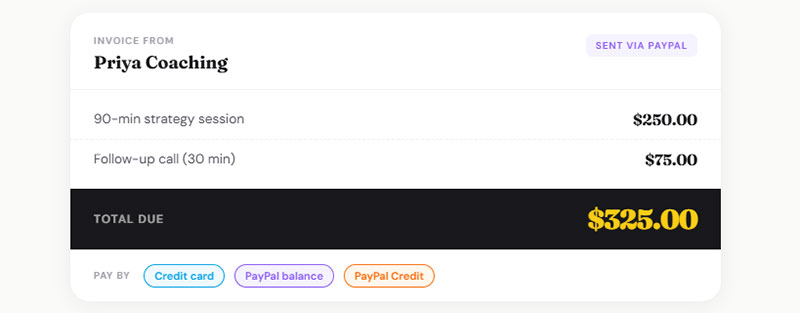
Not every business needs a full scheduling platform. PayPal Invoicing works as a lightweight booking payment tool for sole traders and freelancers handling a small number of sessions a week.
It’s simple enough: you create and send a professional invoice through the PayPal Business dashboard, the client gets an email link, and they pay by card, PayPal balance, or PayPal Credit. The PayPal REST API v2 also supports QR code generation directly from an invoice, so clients can scan and pay from any mobile device (PayPal Developer documentation).
Invoicing won’t automate calendar blocking or send booking confirmation emails. It handles the payment only. Pair it with a Google Calendar link or a basic booking form for a functional low-overhead setup.
PayPal QR Codes for In-Person Appointment Businesses
Walk-in and hybrid businesses, the salons, barbershops, and yoga studios with drop-in classes, can use PayPal Business QR codes for on-site payment collection. A client scans the QR at the front desk, completes payment through their PayPal app, and the transaction confirms instantly.
QR codes require a PayPal Business account. The in-person QR transaction rate is 2.29% + $0.09 per transaction, lower than the standard online PayPal Checkout rates (PayPal merchant fee schedule, 2026).
Businesses running a barber booking website alongside walk-in traffic can use the online booking system for pre-scheduled appointments and QR codes for same-day drop-ins, keeping all payments routed through a single PayPal Business account.
PayPal Subscriptions API for Recurring Bookings
Weekly coaching clients. Monthly retainer consultations. Recurring fitness class packages. All of these need a payment method that charges automatically on a set schedule rather than a fresh checkout for every session.
The PayPal Subscriptions API handles recurring billing configurations, including fixed billing cycles, trial periods, and plan upgrades. It’s separate from PayPal Billing Agreements (the older method) and is the current recommended approach for new integrations (PayPal Developer documentation).
Most off-the-shelf booking platforms don’t expose the full Subscriptions API in their UI. Businesses that need true recurring billing automation often need either a custom integration or a platform with native subscription support. Acuity Scheduling handles recurring packages but routes them through Stripe more cleanly than PayPal for this specific use case.
Platforms built for recurring class-based or session-based bookings are worth comparing if recurring billing is central to the business model. A studio scheduling software review shows which platforms have genuine recurring payment support versus basic workarounds.
How Does a PayPal Booking System Handle Cancellations and Refunds?
Cancellations and refunds are where PayPal booking setups create the most operational friction.
The mechanics are straightforward, but the clash between PayPal’s buyer protection policies and a booking platform’s cancellation terms catches businesses off guard.
PayPal’s Refund Window and Fee Structure
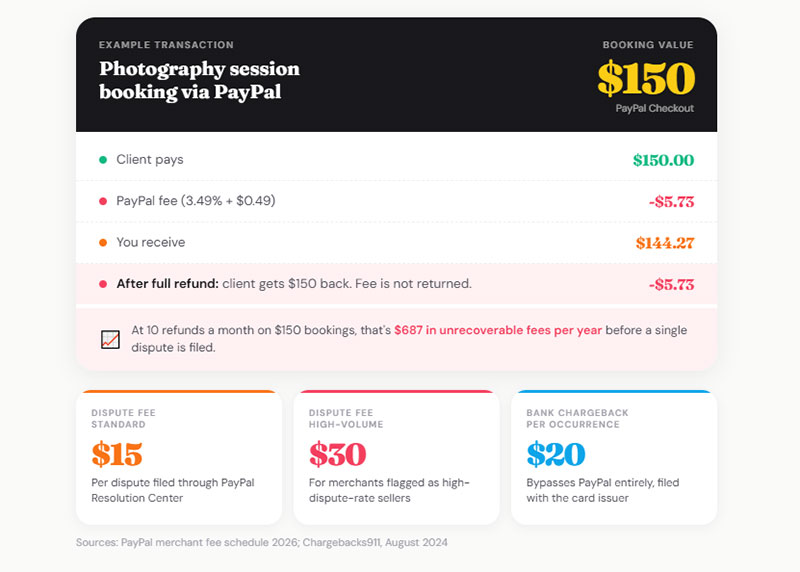
PayPal allows full refunds within 180 days of the original transaction. There’s no refund fee to the merchant, but the original transaction fee doesn’t come back.
On a $150 booking processed through PayPal Checkout, the merchant paid roughly $5.73 in fees (at 3.49% + $0.49). If that booking is refunded in full, the client gets $150 back and the business eats the $5.73 as a sunk cost. At scale, that adds up fast, especially for businesses with frequent cancellations.
Dispute fees apply separately, $15 standard, rising to $30 for high-volume merchants (PayPal merchant fee schedule, 2026). A chargeback through the client’s bank (bypassing PayPal entirely) costs $20 per occurrence (Chargebacks911, August 2024).
PayPal Buyer Protection vs. Booking Cancellation Policies
eCommerce chargeback rates rose 222% between Q1 2023 and Q1 2024 (Sift, Q4 2024 Digital Trust Index). Service businesses with no-refund or limited-refund policies are increasingly exposed.
72% of chargebacks are filed for illegitimate reasons (Chargebacks911, 2024 Cardholder Dispute Index). For booking businesses, “item not as described” and “service not received” are the two most common dispute categories, and both are hard to defend without documentation.
PayPal’s buyer protection can override a booking platform’s stated no-refund policy. A client who books a photography session, attends, then files a dispute claiming the service was “not as described” can initiate a chargeback through their bank. PayPal has 10 days to respond on the merchant’s behalf (PayPal Resolution Center documentation).
Defending successfully comes down to three specific kinds of evidence: the booking confirmation email showing the client acknowledged the cancellation policy, proof of service delivery (photos taken, session logs, communications), and a written record of any post-service contact with the client.
Automating Refunds Through Booking Platforms
Several booking platforms support automated PayPal refunds when a cancellation meets a specific threshold, and that automation matters. A business processing cancellations manually through the PayPal dashboard piles on administrative overhead that compounds at volume.
Acuity Scheduling can trigger refunds automatically when a client cancels within a defined window. Checkfront supports partial and full refund automation for rental and tour operators. SimplyBook.me has configurable cancellation rules with refund triggers.
The practical move is to set the cancellation policy window inside the booking platform to be shorter than PayPal’s dispute filing window (20 days for PayPal disputes, 180 days for chargebacks). A 48-hour cancellation policy with an automated refund outside that window gives the business a defensible paper trail if a dispute lands later.
For businesses managing cancelled appointments at volume, building automated refund logic into the booking platform is worth the configuration time. Manual refund processing through PayPal for every cancellation doesn’t hold up beyond a few bookings a week.
An event registration setup using PayPal runs into the same refund challenges, especially for multi-ticket events where partial refunds (one attendee cancels, the others stay booked) need manual handling unless the platform supports per-attendee refund logic.
How Does Deposit Collection Work in a PayPal Booking System?
Deposit collection is one of the most practical reasons to run a PayPal booking system. Taking a partial payment at booking cuts no-shows, protects revenue, and filters out low-commitment clients before they occupy a slot someone else would have taken.
No-Show Rates and the Financial Case for Deposits
No-show rates across appointment-based businesses run from 15% to 30% (Apptoto / Zenamu, 2025). Hair salons average 15%, fitness trainers 20%, and medical practices climb as high as 23% (Etisia, 2026; NIH systematic review).
For a service business with 30 weekly appointments at an average of $120 each, a 20% no-show rate costs roughly $37,440 in lost annual revenue. SMS reminders cut no-shows by 38-50% (Etisia, 2026). Deposits cut them further by giving the client financial skin in the game.
How PayPal Handles Partial Payments at Booking
| Method | How it works | Platform support |
|---|---|---|
| Split payment (platform-level) | Platform charges deposit at booking, balance collected later via separate PayPal transaction | Acuity Checkfront SimplyBook.me Trafft Amelia |
| PayPal Orders API partial capture | Authorize full amount at booking, capture deposit only, capture balance later | Custom integrations only |
The platform-level split payment approach is the one most businesses actually use. It charges the deposit as a separate complete PayPal transaction, not a partial capture of the total, which means two separate PayPal fees apply, one for the deposit and one for the balance. Worth factoring in when you set the deposit amounts.
Setting Deposit Amounts That Actually Reduce No-Shows
A deposit that’s too small doesn’t create enough commitment. A deposit that’s too large creates friction at checkout and drags down conversion.
The amounts tend to settle by business type. Hair and beauty salons usually take 20-30% of the service price. Photographers and videographers run 25-50% of the total package. Tour operators and rental businesses sit at 20-30%, sometimes the full 100% for short bookings. And coaches and therapists often just take the full session fee upfront, since it’s the simplest to administer.
Deposit logic is configured inside the booking platform, not PayPal. The platform passes the deposit amount to PayPal checkout as the transaction value, and PayPal processes it as a standard payment with no awareness that it’s a partial booking payment.
Businesses focused on reducing missed sessions should pair deposit collection with automated appointment reminders. A booking form that collects a deposit and triggers a reminder sequence 48 hours before the session cuts no-shows from both directions, financial commitment and timely notice.
For businesses wanting to see how deposit collection compares across booking tools before committing, a look at how appointment scheduling works effectively across different setups gives a useful framework for weighing platform flexibility against setup complexity.
FAQ on PayPal Booking Systems
Does PayPal have its own booking system?
No. PayPal doesn’t offer a native booking system. It works as the payment gateway layer inside third-party scheduling platforms like Acuity Scheduling, SimplyBook.me, or Bookly. The booking logic, calendar, and availability management come from the platform, not PayPal.
Which booking platforms support PayPal payments?
Acuity Scheduling, SimplyBook.me, Checkfront, Setmore, and Bookly all support PayPal natively. WooCommerce Bookings also works with the WooCommerce PayPal Payments plugin. Most major scheduling tools include PayPal as a supported payment processor in their settings panel.
Can I collect a deposit through PayPal when someone books?
Yes. Platforms like Acuity and Checkfront let you configure a partial deposit at the time of booking. The deposit processes as a standard PayPal transaction, and the remaining balance is collected separately, either manually or through an automated follow-up payment trigger.
What are PayPal’s transaction fees for booking payments?
PayPal charges 3.49% + $0.49 per transaction for standard online payments through PayPal Checkout. Standard card payments processed outside the Checkout flow cost 2.99% + $0.49. In-person QR code payments cost 2.29% + $0.09, the lowest rate PayPal offers for service businesses (PayPal merchant fee schedule, 2026).
How long does PayPal hold funds for new booking businesses?
New PayPal sellers can have payments held for up to 21 days. This applies to accounts with no established payment history. Building a track record with small transactions before launching the full booking system helps clear the hold period faster, per PayPal’s official documentation.
What happens if a client disputes a booking payment through PayPal?
PayPal opens a dispute case and may hold the funds pending resolution. Merchants have 10 days to respond with evidence. A standard dispute fee of $15 applies, rising to $30 for high-volume accounts (merchants with a dispute rate above 1.5%). Chargebacks filed directly through the client’s bank cost $20 per occurrence.
Can PayPal override my booking cancellation policy?
Yes, it can. PayPal’s buyer protection program evaluates disputes independently of your platform’s stated cancellation terms. A client can file a claim even if your policy says no refunds. Documenting the booking confirmation, the policy acknowledgment, and any service delivery evidence is your best defense.
Does PayPal support recurring payments for regular booking clients?
Yes, through the PayPal Subscriptions API. It supports fixed billing cycles, trial periods, and plan changes for recurring sessions like weekly coaching or monthly retainers. Most off-the-shelf booking platforms don’t expose this fully, so custom integrations or Stripe may handle recurring billing more cleanly.
Is PayPal or Stripe better for a booking system?
PayPal wins on consumer brand recognition with 434 million active accounts (end of 2024). Stripe wins on lower fixed fees ($0.30 vs $0.49), broader currency support (135 vs 25 currencies), and cleaner recurring billing through its native Subscriptions API. Platforms like Acuity let you connect both at once.
Can I use PayPal for event ticket booking and registration?
Yes. PayPal integrates with event registration platforms and supports ticket payment collection through standard checkout. It also works with PayPal Pay Later for higher-priced events, letting attendees split the cost into installments while the organizer receives the full amount upfront from PayPal.
Conclusion
This conclusion is for an article presenting the full picture of what a PayPal booking system actually involves, from integration mechanics to real operational costs.
PayPal works well as a payment gateway for appointment scheduling, but it is never the whole solution.
The scheduling interface, calendar availability engine, and booking confirmation logic all live inside the platform you choose, whether that is Acuity Scheduling, Checkfront, SimplyBook.me, or a WordPress-based setup.
Deposit collection reduces no-shows. The PayPal Subscriptions API handles recurring sessions. Buyer protection disputes require documentation from day one.
Pick the right booking platform for your business type, connect PayPal through the Developer Dashboard, test thoroughly in sandbox mode, and the system runs itself.

Explore topics

Read Inspiring Customer Stories
Check out how our user set Amelia for his business