



A hair salon and a spin studio are really two different businesses, even though both of them “take bookings.” At the salon, a client books time with one particular stylist. At the studio, a client buys a pack of classes and drops into whichever session suits.
Vagaro is built around the first kind of business and Mindbody around the second, and most of what follows, the price, the scheduling tools, the marketing, comes out of that one difference.
Both handle online booking, payments and client management, so on paper they look like rivals. What actually decides between them isn’t the feature count. It’s whether your clients book a person or buy passes.
What Are Vagaro and Mindbody?
Fred Helou founded Vagaro in 2009 as a cloud-based management platform for salons, spas and fitness businesses. It covers online booking, appointment scheduling, payment processing, staff management and client communication for service businesses. It hit unicorn status in 2021, raising from FTV Capital at a $1 billion valuation, and in January 2025 it bought Schedulicity, widening its footprint in salon and wellness scheduling.
Mindbody goes back further, to 2001, when Rick Stollmeyer and Blake Beltram started it as a wellness and fitness management platform. Its core is class scheduling, membership management and marketing automation, wrapped around a consumer-facing marketplace that points fitness studios, spas and salons at new clients.
Both cover the basics any appointment-based business needs, booking, payments and client management, but they were built for different operational models and different sizes of business.
| Platform | Founded | Primary Market | Business Size Fit |
|---|---|---|---|
| Vagaro | 2009 | Salons, spas, independent practitioners | Solo to mid-size 1–15 staff |
| Mindbody | 2001 | Fitness studios, wellness chains | Mid-size to enterprise 10+ staff |
Vagaro reports more than 83,000 businesses leaning on it every day (Vagaro, 2025), mostly individual service providers in health, wellness, cosmetics and personal care worldwide.
Mindbody runs across 130+ countries and serves 60,000+ businesses as of 2025 (Wellyx, 2025). Its consumer app connects more than 2.8 million active monthly users with gyms, studios, spas and salons (Mindbody, 2025).
On the surface the product categories line up almost exactly: online booking, payment processing, staff scheduling, client management and marketing tools. The differences live in the depth, the pricing and the operational model each was designed around.
Mindbody and ClassPass came under the same ownership in 2021, the same year Mindbody took $500 million from Sixth Street Partners, which says a lot about where it’s positioned: the enterprise end.
Who Is Each Platform Built For?
Before you weigh up a single feature or price, the question that matters is whether your business runs on an appointment model or a class-pass model.
In an appointment model, a client books time with a specific provider, a stylist, a massage therapist, an esthetician. The class-pass model works differently: clients buy passes and turn up to scheduled group sessions led by whichever instructor is on.
Vagaro grew up around the first model and Mindbody around the second. Each can technically do both, but each is noticeably better at the one it was made for.
Who Uses Vagaro?
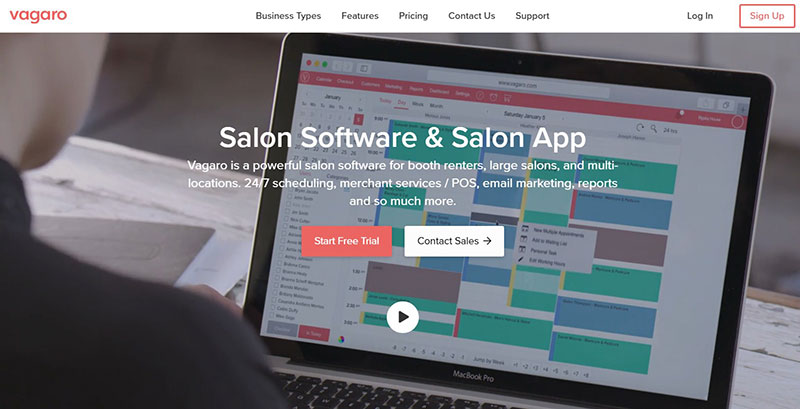
By Capterra’s verified review data (2025), Vagaro’s user base is led by health, wellness and fitness (28%), then cosmetics (20%) and consumer services (17%).
It fits best for:
- Solo practitioners and independent stylists, estheticians and massage therapists.
- Small salons, spas and barbershops with 1 to 7 staff.
- Personal trainers and wellness coaches running one-on-one appointments.
- Budget-conscious operators who’d take low monthly costs over advanced features.
Single-location setups with fewer than 200 active members get the full value of Vagaro without bumping into its limits. Go past that and the class management and multi-location tools start to feel tight.
Who Uses Mindbody?
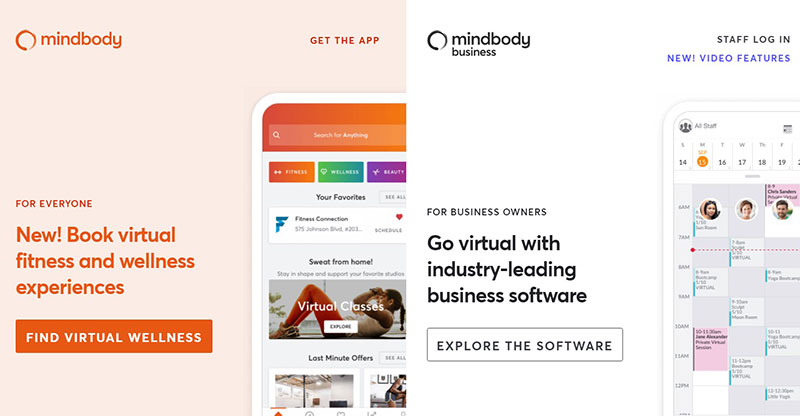
Mindbody’s core is fitness: yoga, Pilates, cycling and barre studios. Bigger names run on it too, including Orangetheory Fitness and Drybar (Mindbody, 2024).
It fits best for:
- Multi-location fitness studios and wellness chains.
- Businesses running group class schedules with multiple instructors.
- Operators who need marketplace exposure to bring in new clients.
The global fitness and wellness software market is projected to grow from $81.90 billion in 2024 to $133.70 billion by 2030, an 8.51% CAGR (Arizton, 2024). Both are chasing a slice of that, just in different segments.
The Business Model Test
It really comes down to one thing: do your clients book time with a specific person, or do they buy passes and drop into scheduled classes?
Book a specific person and Vagaro’s model fits without effort. Sell passes into scheduled classes and Mindbody’s whole architecture was built for that. Pick the wrong one and you’ll be fighting your software from day one (Aplos AI, 2026).
How Do Vagaro and Mindbody Compare on Pricing?
Vagaro opens a lot cheaper and Mindbody a lot dearer, but on both the advertised base price hides the real monthly bill once you add the add-ons, the processing fees and the per-location charges.
Vagaro Pricing Breakdown
Vagaro charges by the number of bookable calendars at one location.
The base runs from $30/month for one calendar to $90/month for seven or more, going by G2 and Pabau pricing data (2026), with a promotional $23.99/month sometimes on offer for new sign-ups.
Every extra staff calendar tacks on $10/month, so a 3-person salon is at $30 base plus $20 for two more calendars, $50/month minimum, just to get scheduling access.
The tools you might assume are included, but aren’t, all cost extra:
- Text marketing: $20/month.
- Online intake forms: $10/month.
- Website builder (MySite): $20/month.
- Vagaro Drive cloud storage: $10/month.
- Branded mobile app: $100/month.
- Payroll: $34/month base plus $5 per employee per month.
A 3-person salon running scheduling, text marketing, forms and a website builder realistically lands at $100 to $150/month before any payment processing (Koalendar, 2026).
Processing rates sit between 2.2% and 3.5% depending on your monthly volume. On $10,000/month in bookings, that’s another $2,640 to $4,200 a year in processing alone.
Mindbody Pricing Breakdown
Mindbody’s main tiers are priced per location.
| Plan | Approx. Monthly Cost | Key Features |
|---|---|---|
| Starter | $99–$159 /mo per location |
Booking, payments, basic reporting, marketplace listing |
| Accelerate | $259–$279 /mo per location |
Starter + advanced reporting, resource management, marketing tools |
| Ultimate | $499–$699 /mo per location |
Accelerate + marketing automation, SMS campaigns, referral programs |
Billing is per location, not per business. A 3-location studio on Accelerate is looking at roughly $780 to $840/month before anything else gets added (CheckThat.ai, 2026).
The cost most operators miss is the 20% marketplace commission on new client bookings made through the Mindbody app. On a $100 booking from a new marketplace client, Mindbody takes $20, then a 3.5% processing fee on top, which comes to 23.5% of the transaction (Gymdesk, 2026).
Plenty of studios deliberately steer clients to book through their own website rather than the Mindbody app, purely to dodge that commission.
True Monthly Cost by Business Size
For a solo practitioner, Vagaro wins outright at $30/month against Mindbody’s $99-plus Starter plan.
At a 5-person salon or spa, Vagaro runs $70 to $130/month with add-ons and Mindbody Starter runs $99 to $159/month. The costs overlap, but at this tier Vagaro packs in more of the tools an appointment-based business actually uses.
For a multi-location fitness studio, Mindbody at $259 to $499 per location per month brings features Vagaro can’t match, and the price gap gets easier to justify as the business gets more complex.
Gartner’s SMB Software Report found wellness businesses on integrated studio-management and automation platforms report 22 to 28% higher member retention than those on manual or siloed systems. At scale, that kind of lift can pay for a pricier platform on its own.
How Do Their Booking and Scheduling Features Compare?
Both handle appointment booking and class scheduling. The gap shows up in how deep the class management goes, how they juggle multi-location calendars and what the client-facing booking feels like.
Online Booking and Client Experience
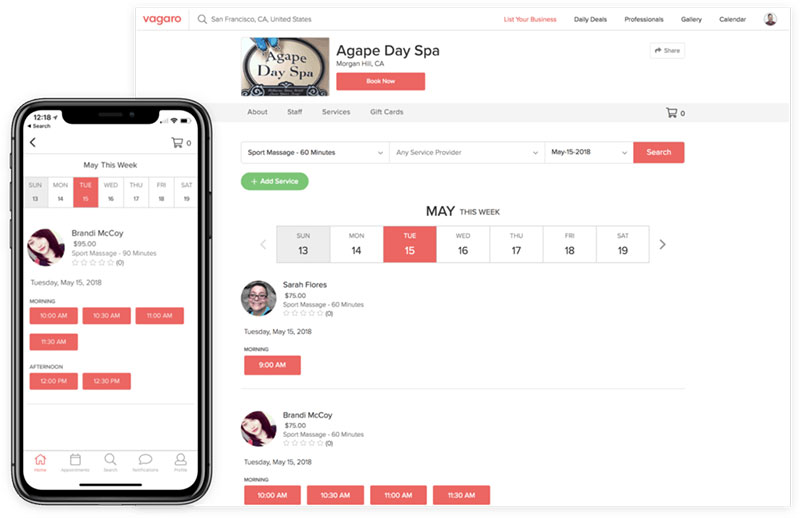
Capterra’s verified user data (2025) has Vagaro’s confirmation and reminder tools rated as more consistently reliable. Its users report fewer missed notifications, while Mindbody users like the customization but flag the odd reliability problem where confirmations don’t go out.
On either one, clients can book through:
- A branded business booking page.
- Embedded website booking widgets.
- Instagram and Facebook booking integrations.
- The platform’s own consumer marketplace app.
Mindbody’s consumer app puts clients in front of 2.8+ million active monthly users and over 65,000 providers worldwide. Vagaro’s marketplace is smaller, but it still drives some local discovery for listed businesses (Mindbody, 2025).
Class and Appointment Scheduling Tools
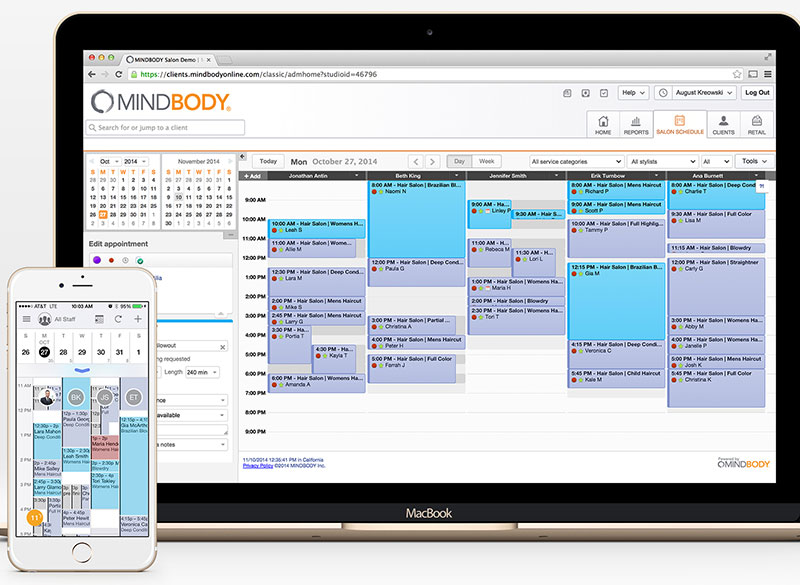
Vagaro’s strengths on scheduling are speed and simplicity: a fast setup, a gentle learning curve, dependable recurring appointments, waitlist management and multi-staff calendar views. Most small businesses are fully running inside a day.
Mindbody’s strengths sit at the other end: deep class management for studios with many instructors, resource scheduling for specific rooms or equipment, pick-a-spot booking for clients, and one calendar view across multiple locations.
A yoga or Pilates studio running 20-plus classes a week with rotating instructors is materially better off on Mindbody. A 4-person spa where clients always book the same therapist is better served by Vagaro’s simpler model.
Mobile App Functionality
Both ship staff-facing and client-facing apps on iOS and Android.
Reviewers consistently praise Vagaro’s app for being easy during checkout and calendar management. Mindbody’s does more, but staff face a steeper climb learning the back end.
Mindbody said its app was downloaded more than 6 times a minute in 2025 (Mindbody Enterprise, 2025), though that volume reflects the consumer marketplace reach more than the business-management side.
How Do Payment Processing and POS Features Compare?
Each platform has its own built-in payment product, Vagaro Pay and Mindbody Payments.
Neither is the cheapest processor around, and both tie you into their own processing as part of the subscription.
Vagaro Pay
Vagaro Pay runs 2.2% to 3.5% depending on monthly volume. Smaller merchants under $4,000/month pay the higher end; once you clear $4,000/month you drop to the lower rates, though that large-merchant status carries a $10/month subscription fee.
It takes card-present swipe and tap, keyed-in transactions and online payments, and it can charge cancellation fees, no-show fees and deposits straight to a card on file. Handling cancelled appointments with automatic card-on-file charges is one of the cleaner ways to protect revenue.
On hardware there are Bluetooth card readers and countertop terminals, and in late 2024 Vagaro added tap-to-pay on iPhones and Android devices, which removes the need for external hardware in some cases (Vagaro, 2025).
Mindbody Payments
Mindbody Payments runs roughly 2.75% + $0.25 per card-present transaction. Card-not-present online ones run higher, usually around 3.5% + $0.30.
Automatic recurring charges, meaning membership billing, get processed as card-not-present, so you pay that higher rate on every renewal. For a studio with 200-plus active memberships that adds up quickly.
And the 20% marketplace commission on new app bookings stacks on top of the usual processing, bringing the combined cost on a marketplace booking to 23.5% of its value (Gymdesk, 2026).
Membership and Recurring Billing
Depth of membership billing is one of Mindbody’s clearest advantages. A class-based studio needs flexible structures, the unlimited plans, the class packs, the ability to freeze, the auto-renewal logic across locations, and Mindbody does all of that natively from the Accelerate tier up.
Vagaro does membership and recurring billing at a basic level. Straightforward monthly billing is fine; it’s the complex multi-tier memberships with location-sharing rules where it starts to show its limits.
How Do Marketing and Client Retention Tools Compare?
Marketing is where the two pull apart most. Mindbody was built for growth-minded operators who actively spend on acquiring clients, whereas Vagaro is for people who want the booking solid first and treat marketing as the next thing down the list.
Email and SMS Marketing
Vagaro’s base plan throws in 1,000 free email marketing messages a month, with SMS marketing a $20/month add-on. Campaigns cover appointment reminders, promotions and basic automated follow-ups.
Mindbody’s email and SMS marketing arrives at the Accelerate tier ($259 to $279/month), and it’s a deeper set: automated email campaigns, client segmentation, smart contact lists, promo-code tools and triggered text campaigns.
For a growing salon with 500-plus active clients, Vagaro’s marketing tends to feel limiting inside 12 to 18 months (Pabau, 2026). It runs basic campaigns fine but doesn’t have the behavioural segmentation a serious retention program needs. Salons looking to push beyond basic reminders might look at dedicated salon promotion ideas to complement whatever platform they choose.
Automated Client Retention Tools
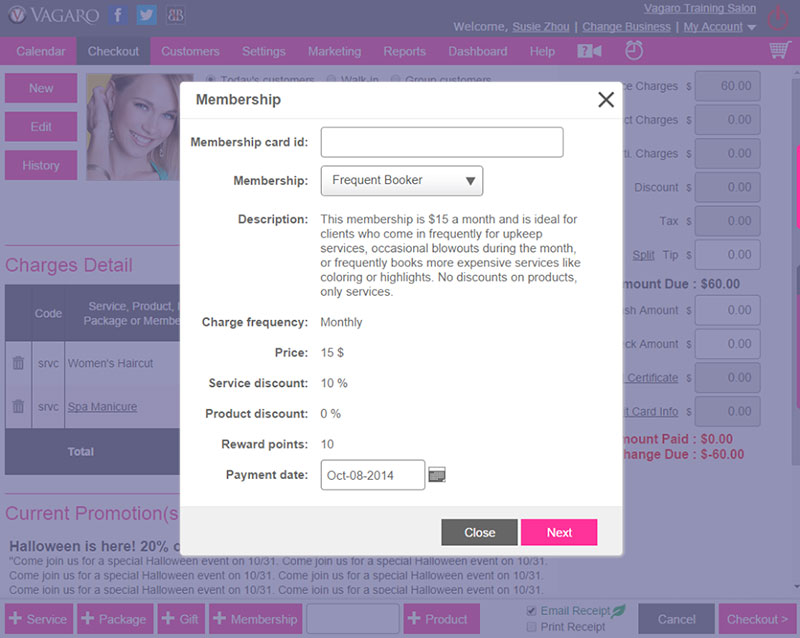
Mindbody’s retention automation covers:
- AI-driven re-engagement campaigns for lapsed clients.
- Automated birthday and milestone messages.
- Client lifetime value tracking with reporting dashboards.
- Lead pipeline management for converting new clients.
Vagaro’s automation does rebooking reminders, lapsed-client outreach and promotional texts, which is enough for most small businesses. Multi-touch conditional campaigns and segmentation based on attendance patterns need Mindbody’s higher tiers or a third-party tool.
Forrester Research has fitness and wellness businesses losing 25 to 40% of their potential lifetime member value to weak automated engagement between visits. That’s the case, in one number, for putting money into deeper marketing automation once a studio pushes past 200 active members.
Consumer Marketplace and Client Discovery
The consumer marketplace is a genuine differentiator for Mindbody. Its app puts paying customers who are actively hunting for fitness and wellness nearby in front of listed businesses, and for yoga studios and fitness chains that exposure brings in new clients without extra ad spend.
Vagaro lists businesses on a marketplace too, but it’s smaller than Mindbody’s on active consumer traffic. A steady complaint in Vagaro reviews is that the marketplace brings in few inbound clients, with most bookings still coming from operators’ own marketing (Capterra reviews, 2025).
Mindbody’s 2025 State of the Industry Report found 72% of fitness and wellness operators are optimistic about the year ahead, and the ones actively investing in technology were 1.6x more likely to call themselves very optimistic (Mindbody, 2025). It points to an industry leaning toward platforms that drive growth, not only ones that keep the lights on.
How Do Reporting and Business Analytics Compare?
On both, reporting depth tracks your plan tier. Everyone gets basic dashboards; the analytics you’d actually make decisions on sit behind upgrades on either platform, but Mindbody’s ceiling is the higher of the two.
Vagaro Reporting
Vagaro’s standard reports cover revenue by service and provider, appointment volume, staff performance, product sales and basic retention metrics.
Every plan includes daily, weekly and monthly revenue summaries, appointment completion rates, gift-card tracking and basic payroll data.
The interface is clean and works for non-technical users. Most small-business owners get what they need from the dashboards without exporting anywhere.
QuickBooks and Xero connect as paid add-ons ($10 to $30/month), wiring Vagaro’s transaction data into external accounting. The link works, but you set it up by hand and keep an eye on it for accuracy.
Mindbody Reporting
Mindbody’s reporting scales with the tier. Starter gives you basic sales and booking data. Accelerate layers on advanced reporting with resource utilization, client segmentation and revenue forecasting. Ultimate adds custom dashboards and real-time analytics.
What Accelerate adds on the reporting side:
- Visit-trend analysis and attendance patterns by class, time and instructor.
- Membership churn metrics and at-risk client flags.
- Revenue per class and per instructor.
- Multi-location performance comparisons.
Orangetheory Fitness and operators like it rely on that centralized reporting to watch dozens of locations from one dashboard, which is exactly the infrastructure Mindbody provides from Accelerate up.
For a solo practitioner or a 3-person salon that’s all overkill. For a fitness brand running 10+ locations and 1,000+ active memberships, the analytics gap between Vagaro and Mindbody’s Accelerate plan is real and it matters.
How Do Their Integrations and API Access Compare?
Both connect to outside tools, but the ecosystems are different sizes. Mindbody was built for operators who need their software talking to CRMs, marketing platforms and access-control systems. Vagaro covers the basics well and stops there.
| Integration Category | Vagaro | Mindbody |
|---|---|---|
| Accounting | QuickBooksXero paid add-on | QuickBooksXeroStripe |
| Marketing / CRM | MailchimpGoogle Calendar | HubSpotKlaviyoSalesforceActiveCampaign |
| Zapier Support | Yes webhook add-on · $10/mo | Yes included on applicable plans |
| API Access | Limited read-only · no write API for classes | Full Public API v6 OAuth 2.0 |
Vagaro’s Integration Ecosystem
Vagaro integrates natively with QuickBooks, Xero, Google Calendar, Mailchimp, Instagram, Facebook and Gusto (Goodcall, 2024).
Webhook access is a $10/month extra and you need it for most third-party automation. The API also can’t create or update classes through API calls right now, which limits automation for class-based businesses (Vagaro Support, 2025).
There’s a sharper issue too: some users report being declined webhook access while still being charged the monthly fee, which has annoyed operators trying to hook up AI receptionist tools (Trustpilot, 2026).
Mindbody’s Integration Ecosystem
Mindbody’s Partner Marketplace carries integrations across accounting, CRM, marketing, access control and virtual-class tools.
Mindbody customers who use integrations earn 10% more revenue, take 40% more bookings and see around 35% more client purchases than those who don’t (Mindbody Integrations, 2025), which is a fair argument for buying into the wider ecosystem.
The Public API v6 uses standard OAuth 2.0 and can read and write bookings, clients, payments, class schedules, staff profiles and membership data (Mindbody Developer Portal, 2025). Full access means joining the Partner Program through the Developer Portal.
Zapier and No-Code Automation
Both connect to Zapier. Mindbody exposes 130+ triggers and actions through it, covering class bookings, membership renewals, no-shows and package-expiration events (Flozic, 2026).
Vagaro’s Zapier link runs through that $10/month webhook system, and the triggers are narrower, handling appointment bookings and changes but not the wider set of class and membership events Mindbody opens up.
How Do Customer Support and Onboarding Compare?
Support is where both take consistent knocks in reviews. Neither comes out clean, but they fail in different ways.
Vagaro Support
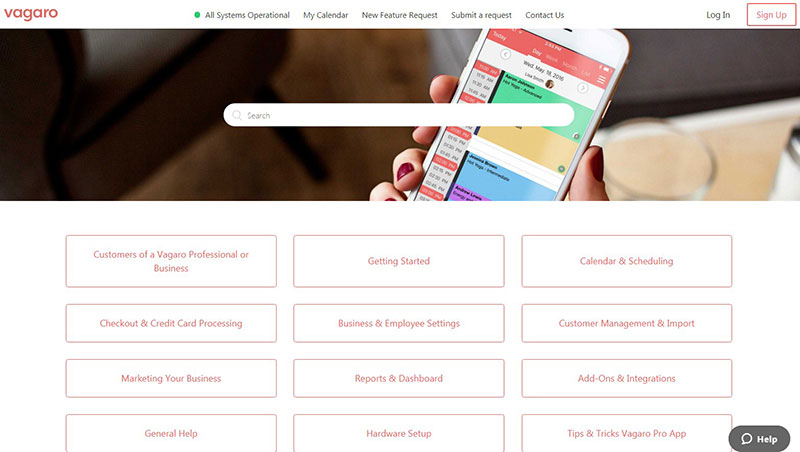
Vagaro runs 24/7 phone support, live chat and email, and plenty of Trustpilot reviewers single out having live agents available around the clock.
The other side of it, from BBB and Trustpilot complaints across 2024 to 2026, is slow resolution on payment processing glitches, billing disputes where refunds got denied, and cases that stalled for weeks (BBB, 2025 to 2026).
Capterra’s verified reviewers (2025) are warmer overall, praising how easy support is to reach and how helpful that first contact is. The complaints cluster in the gap between that first contact and an issue actually getting resolved.
Mindbody Support
Mindbody’s most-cited support complaint on G2 is complexity, with users having to work through several contacts to resolve one issue, and some describing account reps going quiet for long stretches (Capterra, 2025 to 2026).
It holds a 3.6/5 value-for-money score on Capterra (Gymdesk, 2026), which reflects the frustration over cost versus support on the lower tiers. Higher-tier customers report better treatment, with dedicated account management and quarterly business reviews at the enterprise level.
Onboarding can stretch to 8 weeks for a complex multi-location setup (Capterra, 2026). Mindbody does offer free done-for-you setup that moves your client data over from a previous platform at no cost (Mindbody, 2025). Vagaro is far quicker, with most small businesses up and running within 24 hours.
Support Channel Comparison
Vagaro gives you 24/7 phone, live chat, email, Vagaro University with self-service video tutorials, and help-center articles.
Mindbody runs a 24/7 AI assistant (Messenger[ai]) alongside live chat and phone support, dedicated account management on enterprise plans, and a Developer Portal for API help.
Alloy Personal Training Lincoln Park, which runs scheduling and membership management on Mindbody, pointed to centralized reporting and automated processes as time-savers that took admin load off its coaching staff (G2, 2025).
What Do Users Say About Vagaro vs Mindbody?
Pull the review data together from G2, Capterra and Trustpilot and a fairly consistent picture shows up on both.
Vagaro User Review Summary
Vagaro holds 4.7/5 overall on Capterra and 4.4/5 for value for money across verified reviews (Capterra, 2025).
What reviewers on G2 and Capterra praise most:
- Affordable entry-level pricing for solo and small-team operators.
- A clean, intuitive calendar interface staff pick up fast.
- Reliable appointment reminders that cut no-shows.
- Responsive 24/7 phone support on first contact.
What they complain about most:
- Add-on costs that inflate the bill well past the advertised price.
- Payment processing glitches and account lockouts.
- Limited advanced reporting and analytics.
- A marketplace that brings little organic client traffic for many businesses.
Mindbody User Review Summary
Mindbody holds 4.0/5 overall on Capterra across 2,927 verified reviews (Capterra, 2026).
On G2 the positives, by mention count, are ease of scheduling (54), responsive support (37), organized client management (28) and a user-friendly interface (22).
The negatives run poor usability on complex workflows (26), missing features (24), pricing that’s high for the value (20), and bugs and inconsistencies (20).
Contract practices come up again and again in Capterra reviews, with several users saying they were locked into annual contracts they hadn’t fully grasped at sign-up, and little recourse to leave early (Capterra, 2025 to 2026). It’s worth pinning that down with Mindbody’s sales team before you commit.
Where Does Each Platform Fall Short?
No platform covers every use case cleanly, and both have documented weak points that matter depending on what kind of business you run.
Vagaro’s Documented Limitations
The first is class-based scheduling depth. Vagaro does classes, but studios with complex multi-instructor timetables find it cramped next to Mindbody, and businesses past 200 active members often hit the ceiling on class-management tools (Pabau, 2026).
The second is multi-location management. A franchise running 10+ locations would find Vagaro’s cross-location reporting and membership-sharing too thin (Pabau, 2026). It’s fine for 2 to 3 locations but lacks the centralized governance multi-site operators need.
Advanced reporting gets flagged consistently. Anyone wanting behavioural segmentation, churn prediction or attendance-trend analysis finds the dashboards too shallow, and connecting a BI tool like Power BI means setting up Vagaro’s Data Lake, which adds both complexity and cost.
Mindbody’s Documented Limitations
The biggest barrier is onboarding complexity. Standing Mindbody up for a multi-location studio with complex class schedules can take 4 to 8 weeks, and small businesses consistently say the learning curve eats more time than they planned for (Capterra, 2026).
Then there’s cost creep. One Trustpilot reviewer tracked their bill going from $80/month in 2015 to $469/month by 2025 as tiers shifted and add-ons piled up (Goodcall, 2026). Annual contracts on the higher tiers also lock you into prices that can climb at renewal.
And the 20% marketplace commission on new client bookings hits hard for studios that lean on the app to find clients. In competitive markets with heavy app-driven volume, that’s 23.5% per transaction once you add processing, straight out of the margin.
Exit Friction
Leaving either one is genuinely awkward. Both keep client data, booking history, payment records and membership details in proprietary formats.
Mindbody will help migrate your data in from another platform. Getting it back out on the way is a different conversation, and the annual terms on higher tiers mean leaving early often costs you.
Vagaro’s month-to-month billing makes the exit easier, though anyone who built their client base through its marketplace or embedded booking widgets still has the real work of moving booking flows, notification settings and client communication history.
Which Platform Is Better for Specific Business Types?
The right call comes down to what kind of business you run and where you expect to be in 18 months.
| Business Type | Better Fit | Key Reason |
|---|---|---|
| Solo practitioner / independent stylist | Vagaro | $30/month base, fast setup, no contract |
| Small salon or spa 2–7 staff | Vagaro | Per-calendar pricing, appointment model fit |
| Yoga / Pilates / cycling studio | Mindbody | Class scheduling depth, marketplace discovery |
| Multi-location fitness chain | Mindbody | Centralized management, enterprise reporting |
| Barbershop 1–4 chairs | Vagaro | Low cost, fast client self-booking |
Solo Practitioners and Independent Operators
Vagaro wins this one without much argument. A solo massage therapist, esthetician or personal trainer pays $30/month for online booking, client management, payment processing and a marketplace listing. Mindbody’s $99-plus Starter plan is hard to justify for a single-provider shop.
If you’re thinking about building a beauty salon booking website to sit alongside your booking software, that front-end infrastructure matters about as much as whichever backend you pick.
Small Studios (2 to 10 Staff)
Vagaro is the default up to about 7 or 8 staff. At $30 to $90/month for scheduling plus add-ons, it handles everything a small appointment-based business needs for $100 to $150/month all in.
If your model is mostly class-based, group fitness, yoga, cycling, Mindbody’s Starter plan at $99 to $159/month is worth a serious look even with a small team. The class scheduling and the marketplace exposure justify the higher base if you’re selling passes rather than individual appointments.
For a small studio weighing up scheduling software built for small businesses, the appointment-versus-class question matters more than the feature count when you make the final call.
Multi-Location Businesses
This is the scenario Mindbody was built for. Centralized reporting across sites, membership cards that work at any location, staff scheduling that accounts for multi-site complexity and enterprise governance controls all live at the Accelerate tier or above.
Vagaro works for 2 to 3 locations under one owner with relatively simple cross-location needs. Beyond that, the reporting and membership-management limits turn into operational problems.
Fitness-Specific Businesses
For gyms, yoga studios, Pilates centres, cycling studios and barre studios, Mindbody is the default. The class scheduling depth, the retention automation and the marketplace exposure were all built for exactly this, and both Orangetheory Fitness and Drybar run on Mindbody at the enterprise level (Mindbody, 2024).
For an independent personal trainer or a small fitness studio that’s mostly one-on-one, Vagaro handles the studio scheduling workflow at a fraction of the cost. The business model matters more than the fitness label.
Businesses early in the journey might try free options first. There are solid free gym software tools worth testing before paying for either platform, and separately some free yoga studio software for studios that aren’t ready for Mindbody’s pricing yet.
Beauty and Personal Care Businesses
For salons, spas, barbershops and independent beauty pros, Vagaro is the stronger fit. Its booking interface was designed around the individual-provider appointment model these businesses actually run on.
By Capterra’s verified data (2025), cosmetics (20%) and consumer services (17%) are Vagaro’s second and third biggest segments. Beauty and personal care is where its feature set and price point line up most cleanly with what operators actually need.
Mindbody does serve beauty businesses, but the architecture was built for fitness first. Hair salons in particular have said in Capterra reviews that it feels bent to fit the salon use case rather than designed for it (Software Advice, 2025).
If you’re building or refreshing your salon’s online presence next to the booking software, getting a solid hair salon website that ties into your booking flow will shape how many people actually go from finding you to booking. The same holds for barbershop websites, where online booking conversion is fast becoming a baseline expectation.
Spa operators specifically should look at dedicated spa scheduling software and weigh it against both Vagaro and Mindbody before signing up for either.
FAQ on Vagaro vs Mindbody
Is Vagaro cheaper than Mindbody?
Yes. Vagaro starts at $30/month for a single bookable calendar, while Mindbody’s Starter begins at $99/month per location. At comparable team sizes Vagaro is much cheaper, though add-ons on both push the real bill up.
Which platform is better for yoga studios?
Mindbody. Its class scheduling, the depth of its membership management and the marketplace exposure were all built for class-based businesses running several sessions a week with rotating instructors. Studios that aren’t yet ready for Mindbody’s price point might also explore dedicated yoga studio software options before committing.
Does Vagaro have a free trial?
Yes, a 30-day free trial with access to most paid features. Mindbody doesn’t do a free trial; it offers a personalized demo and free onboarding help instead, which fits its higher-touch sales process.
Can Vagaro handle multiple locations?
It supports them, but it’s at its best with 2 to 3 sites and straightforward needs. For 10+ locations needing centralized reporting, membership sharing and staff governance across sites, Mindbody’s enterprise tools are materially more capable.
Does Mindbody charge a commission on bookings?
Yes. It charges a 20% commission on new client bookings made through its consumer app marketplace. Add the standard 3.5% processing and the total on a marketplace transaction reaches 23.5% per booking.
Which platform is easier to set up?
Vagaro, by a distance. Most small businesses are running within a day, whereas Mindbody onboarding can take 4 to 8 weeks for a complex multi-location setup. For solo practitioners and small salons, that speed is a real advantage. If you want to set up effective appointment scheduling as quickly as possible, Vagaro is the more practical starting point.
Is Mindbody good for salons?
It works for salons, but it was built mainly for fitness studios, and some salon owners say it feels adapted rather than purpose-built for beauty. Vagaro is the more natural fit for salons, spas and barbershops. For salons exploring their options, the guides to free salon software and salon bookers are worth a look before spending anything.
What integrations does Vagaro support?
Vagaro connects natively with QuickBooks, Xero, Google Calendar, Mailchimp, Instagram and Facebook. Zapier access needs the $10/month webhook add-on. Mindbody’s ecosystem is wider, reaching CRMs like Salesforce, HubSpot, Klaviyo and ActiveCampaign.
Which platform has better customer support?
Both get mixed reviews on support. Vagaro has 24/7 phone access and generally positive first-contact ratings. Mindbody holds a 3.6/5 value-for-money score on Capterra, with recurring complaints about response times and contract disputes on the lower tiers.
Can I switch from Mindbody to Vagaro?
Yes. Vagaro offers account-transfer help and data-migration support, though the real work is moving client records, booking flows and payment data. Mindbody’s annual contracts on higher tiers can carry early-exit penalties, so check< your terms before switching.
Conclusion
This conclusion is for an article presenting the Vagaro vs Mindbody decision as one that hinges on your operational model, not your budget alone.
Vagaro wins for salon management, spa booking, and independent practitioners who need affordable scheduling without a steep learning curve.
Mindbody wins for fitness studios, yoga and Pilates centers, and multi-location wellness businesses that depend on class scheduling, membership billing, and consumer marketplace discovery.
Neither platform is universally better. The wrong choice means paying for features you won’t use, or hitting a ceiling exactly when your client management needs grow.
Match the platform to your business management software requirements first. Price follows from there.

Explore topics

Read Inspiring Customer Stories
Check out how our user set Amelia for his business