



Acuity Scheduling and Setmore both do online booking, calendar sync and reminders, so on a feature checklist they look close.
The split that actually matters sits further down. Setmore starts free and stays cheap, and it’s quick enough to get a salon or a barbershop taking bookings by tomorrow. Acuity never goes free, opens at $16 a month, and spends that money on depth: packages, memberships, conditional intake forms, HIPAA, real booking-page branding.
So the question isn’t which tool is better made. It’s whether your business needs the deep end. A coach selling 10-session packs or a clinic running branching intake forms will hit Setmore’s ceiling fast. A barbershop that just needs bookings live won’t get much out of paying Acuity for features it never touches.
What Is Acuity Scheduling?
Squarespace has owned Acuity Scheduling since 2019, and it’s their cloud-based booking platform for service businesses. The point of it is client self-scheduling: people pick an open slot, fill in an intake form and pay, with none of the email back-and-forth.
It aims at solo practitioners, small teams and multi-location businesses, mostly across health and wellness, coaching, photography and professional services. It holds a 4.8 out of 5 rating from over 5,700 verified Capterra reviews (Capterra, 2025).
Core Platform Capabilities
Acuity runs entirely in the browser, with nothing to download for clients or admins.
Every paid tier comes with:
- Client self-booking against real-time calendar availability.
- Two-way calendar sync with Google Calendar, Outlook and iCloud.
- Intake forms for collecting client details before the appointment.
- Payment collection through Stripe, Square or PayPal at booking.
- Automated email confirmations and appointment reminders.
SMS reminders, appointment packages and memberships sit behind the Standard plan ($27/month) and up (G2, 2025).
Squarespace Ownership and Ecosystem
What sets Acuity apart from most scheduling tools is that it lives inside the Squarespace ecosystem, and that cuts both ways.
If your site is on Squarespace, the integration is deep and native, with the booking page dropped straight into the site and no code involved. On WordPress, Wix or Webflow you can still embed Acuity, but the brand continuity isn’t as clean. If you’re on WordPress and want tighter control over the booking experience, it’s worth comparing with a dedicated WordPress booking plugin before committing.
The flip side is lock-in. If Squarespace reshuffles pricing or drops a feature, Acuity users don’t have much leverage, which is worth a thought before you sign up for a year.
Pricing Tiers at a Glance
| Plan | Monthly Price | Calendars | Key Unlock |
|---|---|---|---|
| Starter formerly Emerging | $16 /mo annual |
1 | Core scheduling Payments |
| Standard formerly Growing | $27 /mo annual |
6 | SMS reminders Packages Memberships |
| Premium formerly Powerhouse | $49 /mo annual |
36 | HIPAA compliance Multiple time zones |
Paying annually brings Starter down to $16/month and knocks roughly 20% off every tier (Acuity Scheduling, 2025). There’s no permanent free plan anywhere in the lineup.
What Is Setmore?
Where Acuity starts at a price, Setmore starts at nothing. It’s a free-first scheduling platform built for small businesses, salons, fitness studios and multi-staff operations, and since launching in 2011 it’s been one of the few tools whose free plan is genuinely usable rather than a crippled trial.
On G2 it sits at 4.5 out of 5 across more than 268 reviews, and 95% of its users are small businesses (G2, 2025). Software Advice has 87% of verified users recommending it.
Core Platform Capabilities
The free plan covers up to 200 appointments a month, email reminders, a custom booking page, payment processing through Stripe, Square and PayPal, and up to 4 staff calendars.
That last bit matters more than it sounds. Most rivals put payment processing behind a paywall, and Setmore just doesn’t.
What you don’t get on free:
- SMS reminders (Pro plan required).
- Two-way Google Calendar or Outlook sync (Pro plan required).
- Recurring appointments (Pro plan required).
- Setmore branding removal (Pro plan required).
- More than 200 appointments per month (Pro plan required).
Pricing Tiers at a Glance
| Plan | Monthly Price | Users | Key Unlock |
|---|---|---|---|
| Free | $0 | 4 max |
200 bookings/mo Email reminders Payments |
| Pro | $12 /user/mo $5 annually |
∞ | SMS reminders 2-way sync Recurring appointments Unlimited bookings |
The annual discount is steep. Billed yearly, Pro falls from $12/user/month to $5/user/month, a 58% cut (Setmore, 2025), which puts it among the cheapest scheduling options for small businesses going for any team watching every dollar.
Mobile App and Support Model
Setmore’s iOS and Android apps are fully functional for both staff and clients, and the admin controls on mobile go further than Acuity’s app, which keeps management features thin.
The standout is support. Setmore runs 24/7 live chat on every plan, the free tier included, while Acuity keeps live chat to paid plans only. For a business getting going on the free plan, that kind of access counts for more than most line-item feature wins.
How Do Acuity Scheduling and Setmore Compare on Core Booking Features?
Both cover the basics well, the client self-scheduling, calendar sync, automated reminders and payment at booking. The differences are about depth rather than breadth.
There’s research showing patient no-show rates fall by 29% once a self-scheduling tool is in play (DialogHealth, 2024), and both platforms deliver that much. What separates them is how much control you get over the booking experience itself.
Intake Forms and Client Information Collection
Acuity’s intake forms do conditional logic, where a question only shows up if an earlier answer triggers it. That’s handy for therapy practices, health coaches and anyone who needs the intake to branch.
Setmore’s forms gather the basics but don’t branch at all; you get a fixed set of fields and that’s it.
For most service businesses, salons, photographers, consultants, the simpler form is plenty. The branching only earns its place in healthcare, coaching or legal intake, and it’s part of why 22% of Acuity’s user base comes from health and medicine (Software Advice, 2025).
Recurring Appointments and Group Class Support
Setmore does recurring appointments on Pro, and group class scheduling is actually on the free tier, with multi-attendee sessions and seat limits.
Acuity does recurring bookings and group classes too, but group scheduling needs the Standard plan ($27/month). A yoga studio or fitness instructor running regular classes should check their tier before assuming it’s covered.
In practice, the free Setmore plan is the more sensible pick for a fitness studio running group classes on a budget. Acuity’s class management is more configurable, but you pay to unlock it.
Waitlist and Buffer Time Configuration
Acuity has native waitlist management. Once a slot fills, clients can add themselves to a waitlist and get pinged automatically if a spot frees up.
Setmore has nothing like it. If you run high-demand services or limited spots, you’re stuck with a workaround, usually a manual process or some third-party tool.
Both support buffer time between appointments. Acuity gives you more to configure, including different buffer lengths per service type, whereas Setmore sets buffers at the service level with simpler, blunter rules.
How Do the Calendar and Scheduling Interfaces Compare?
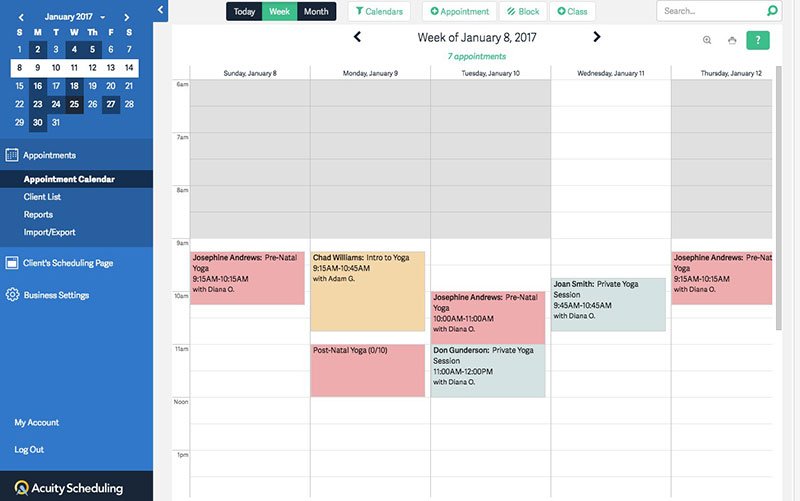
Both show appointments in day, week and month views. The real functional differences are in sync depth, mobile admin and how much you can brand the booking page.
G2 has the two nearly level on ease of use at 9.2, but Setmore pulls ahead on ease of setup at 9.0, so new users get going faster on it (G2, 2025).
Two-Way Calendar Sync
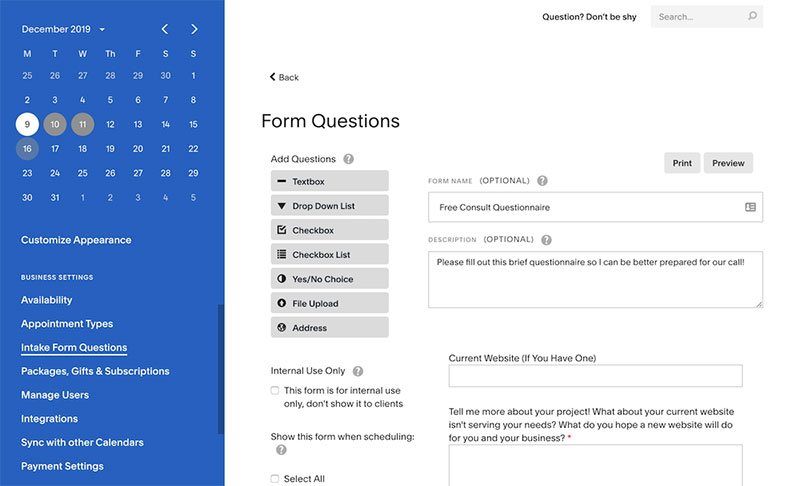
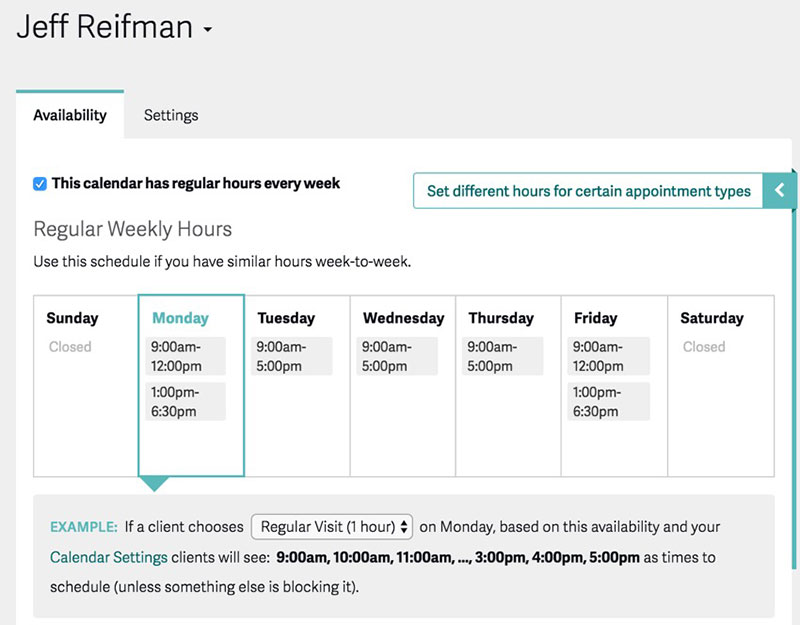
Acuity syncs two-way with Google Calendar, Outlook, iCloud and Office 365 on every paid plan, so a busy block in any connected calendar automatically closes that time off in Acuity.
Setmore’s free plan only syncs one way; two-way sync with Google Calendar or Outlook waits for Pro. That’s a real limitation if you’re juggling a busy personal and professional calendar at once.
Mobile App Admin Controls
Setmore’s app covers the whole admin workflow, from calendar management and booking changes to client notes, payments and push notifications.
Acuity’s app does calendar viewing and basic appointment management, but anything advanced sends you back to the desktop browser. If most of your admin happens on a phone, test that during the trial before you commit.
Booking Page Customization
Acuity gives you full control over colours, fonts, confirmation messages and the booking flow, with CSS customization on the Premium plan for deeper branding.
With Setmore you can drop in a logo, a cover photo and a custom URL, but colours and buttons are off-limits, so the page reads as Setmore no matter which plan you’re on.
If the client-facing brand experience matters to you, and for photographers, creative studios or premium wellness brands it usually does, Acuity’s flexibility is worth the higher price. Setmore’s page is clean and functional, just not yours to brand.
How Do Acuity Scheduling and Setmore Handle Payments?
Both take payment at booking, but the gap is wide. Acuity’s payment processing scores 9.5 on G2 against Setmore’s 8.1, which points to a real difference in reliability and depth (G2, 2025).
For any business where the booking is the transaction, that gap matters more than almost anything else here.
Payment Processor Integrations
Acuity connects to Stripe, Square and PayPal, and deposits, full prepayment and tipping all work natively from the Starter plan. If you need a booking system with payment gateway support built into your WordPress site, it’s worth checking how Acuity embeds versus a native plugin.
Setmore uses the same three, Square, Stripe and PayPal, on both free and paid plans. Neither platform charges its own transaction fee beyond what the processor takes.
One practical difference: Acuity handles payment inside the booking flow with no redirect, while some Setmore setups bounce clients to a separate payment page. That redirect adds a small but real drop-off risk where deposit collection is standard.
Packages, Memberships, and Gift Certificates
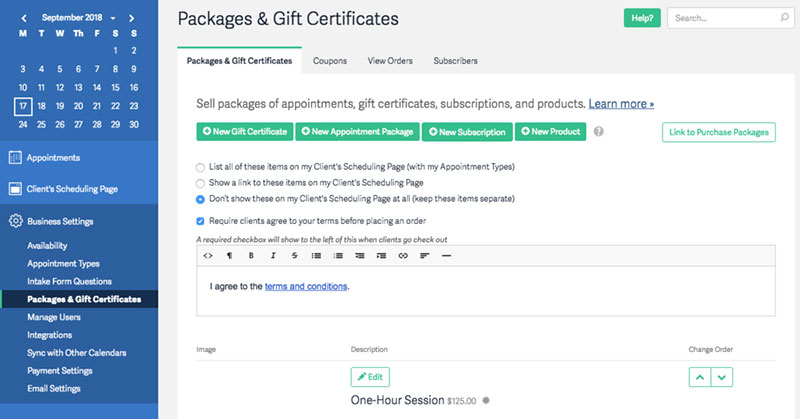
Acuity does packages, memberships and gift certificates natively from the Standard plan up. That’s what lets a coaching business sell a 5-session pack, a yoga studio run monthly memberships, or a spa hand out gift certificates clients redeem at booking.
Setmore has none of that, no packages, memberships or gift certificates on any plan.
This is the single biggest functional gap between them. A wellness booking operation that leans on package sales for recurring revenue simply has no path to it inside Setmore. It’s a hard stop, not something you work around.
How Do Automated Reminders and Client Communication Compare?
Reminders cut no-shows, and the channel matters: Tebra’s 2023 Patient Perspectives report found 67.3% of clients prefer text for appointment reminders over anything else (Tebra, 2023). Both tools send reminders; what differs is what you have to pay to unlock them.
Email and SMS Reminder Access
Acuity sends automated email reminders on every plan, Starter at $16/month included, but SMS reminders need Standard ($27/month) or higher.
Setmore sends email reminders on free and gates SMS behind Pro ($5/user/month annually). For a solo operator that’s $5/month to get SMS, against $27/month for the same thing on Acuity.
On cost, SMS reminders clearly go to Setmore, since the feature unlocks far cheaper.
Follow-Up Emails and Post-Appointment Communication
Acuity can fire automated follow-up emails after an appointment, with custom timing and whatever you want in them, a thank-you, a rebooking nudge, a review request.
Setmore has no native post-appointment follow-up at all. Once the appointment’s done, the automated messaging stops dead.
For anyone working on retention, the repeat bookings, the reviews, the upsell, Acuity’s follow-up email earns its keep. A well-timed appointment confirmation text or follow-up message is one of the simplest ways to keep clients coming back.
Reminder Customization Depth
Acuity lets you edit the templates fully across every reminder type: subject lines, body text, timing windows, even conditional content.
Setmore’s customization is basic by comparison. You can change the message and the timing, but the template structure stays rigid.
How Do Integrations and API Access Compare?
How well a scheduling tool fits an existing tech stack comes down to integration depth. Neither one is weak on this, but they reach into different ecosystems.
The appointment scheduling market is growing at a 16.1% CAGR through 2033, pushed largely by demand for deeper ties into CRM, payment and communication tools (SkyQuest, 2025). Both are responding to that, just from different angles.
Native Integrations
Acuity connects natively to Zoom, Google Meet, Mailchimp, HubSpot, QuickBooks and, of course, Squarespace, and it generates the video link automatically at booking with no setup.
Setmore goes native with Zoom, Google Meet, Teleport, Slack and Salesforce. That Salesforce link is a genuine edge for service businesses running a sales CRM to manage client pipelines.
Acuity’s Squarespace integration is its strongest card in this category. For a business already built on Squarespace, it wipes out the friction between the website and the booking system entirely.
Zapier and API Access
Both connect to Zapier, which stretches their reach a long way. Through it, either tool can push booking data into almost any CRM, email platform or database.
API access lands on Acuity’s Premium plan ($49/month) and Setmore’s Pro plan. For developers building custom workflows or embedding scheduling into a bigger product, both work, though Setmore opens up the API for less.
Video Conferencing Integration
Both auto-generate a video link at booking.
Acuity covers Zoom and Google Meet natively, with GoToMeeting on the menu too; Setmore sticks to Zoom and Teleport. Neither does Microsoft Teams as a native video integration, though Teams users can reach Acuity scheduling through the Microsoft Teams integration announced in March 2024 (Microsoft News Center, 2024).
If your team relies heavily on Zoom, it’s worth reading up on how Zoom integrations work across booking platforms before you choose.
How Does Pricing Compare Across Equivalent Use Cases?
Plan names don’t tell you much. The question that matters is what you actually pay once you’ve got 3 staff, 200-plus appointments a month and a need for SMS reminders.
Setmore’s annual discount is steep, 58%, taking Pro from $12/user/month down to $5/user/month. Acuity’s annual saving is closer to 20% across the board (Setmore, 2025; Acuity Scheduling, 2025).
Solo Practitioner Cost Comparison
On Acuity, Starter runs $16/month for one calendar, email reminders and payments, with no SMS.
Setmore’s free plan is $0 for up to 4 staff and up to 200 appointments a month, with email reminders and payments but, again, no SMS.
For a low-volume solo coach or consultant, Setmore’s free plan handles the basics for nothing, as long as you stay under the 200-appointment cap. Acuity’s $16/month Starter buys you unlimited appointments, two-way calendar sync and more booking-page customization.
Small Team Cost Comparison
| Scenario | Acuity Cost | Setmore Cost | Key Difference |
|---|---|---|---|
| 3 staff, SMS needed | $27 /mo Standard |
$15 /mo 3× Pro annual |
Setmore saves $12/mo |
| 5 staff, SMS needed | $27 /mo Standard |
$25 /mo 5× Pro annual |
Near parity |
| Packages + memberships needed | $27 /mo Standard |
Not available | Acuity only |
High-Volume Business Cost Comparison
Setmore offers no packages, memberships or gift certificates on any plan, which isn’t a pricing gap so much as a capability one.
A studio selling 10-session packs has no Setmore equivalent at any price. Acuity’s Premium plan at $49/month is the only thing in this comparison that handles that workflow.
Pulling the billing together: Setmore saves the most at small team sizes, the 2 to 4 staff who fit inside the 200-appointment cap. Acuity turns into the only real option the moment you need packages, memberships, HIPAA compliance or more than 36 calendars.
Which Industries Use Acuity Scheduling vs Setmore?
Both go after service businesses, but their user bases cluster differently by industry, compliance need and business model.
By Software Advice data from 5,743 verified reviews, Acuity’s users come mostly from health and medicine (22%), retail and consumer services (20%) and professional services (13%) (Software Advice, 2025). Setmore tilts even harder toward health at 34%, with retail and consumer services at 17%.
Where Acuity Scheduling Has an Edge
Healthcare and therapy practices are Acuity’s strongest vertical. HIPAA compliance comes with the Premium plan ($49/month) and means signing a Business Associate Agreement (BAA) with Squarespace, which covers how protected health information (PHI) is handled across the booking process (Acuity Scheduling Help Center, 2025).
It also dominates a few other verticals:
- Photography studios, for the package and deposit workflows.
- Coaching and consulting, for membership billing and intake logic.
- Legal consultations, for conditional intake forms and document capture.
Where Setmore Has an Edge
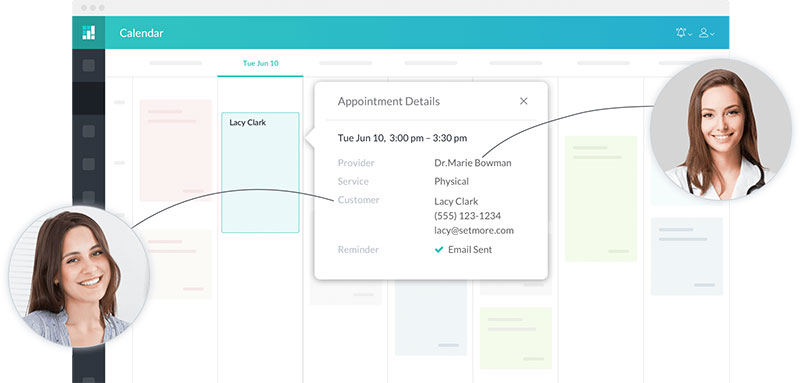
77.49% of barbershop appointments are booked online, going by Mangomint data across 181,180 barbershop bookings (Mangomint, 2024). Between the free plan and the fast setup, Setmore is the default for barbershops and salons that need bookings live by tomorrow.
Where it tends to win:
- Salons and barbershops, for the fast setup, multi-staff free plan and Square integration.
- Fitness studios, for class booking on the free tier and budget-friendly multi-staff pricing.
- Nonprofits and community organizations, where the free plan covers most of what they need.
For anyone building a barber booking website or a beauty salon booking website, the free plan plus multi-language support (21 languages against Acuity’s English-first interface) gives Setmore a practical edge when speed of deployment is the goal.
Overlap Industries
Both serve tutors, personal trainers, chiropractors and massage therapists perfectly well. In those verticals the call comes down to budget and whether you need packages or HIPAA, not which brand suits you.
A personal trainer weighing free personal trainer software options will find Setmore covers the basics for nothing, inside that 200-appointment limit. The ones selling session bundles need Acuity.
HIPAA Compliance: Both Platforms Now Have a Path
Worth stating plainly, because it’s changed: both Acuity and Setmore now offer a HIPAA compliance path, but they do it through different mechanisms and at different plan tiers.
Acuity’s version lives on the Premium plan ($49/month), via a signed BAA with Squarespace, and it complies with HIPAA for PHI inside the booking workflow natively.
Setmore’s runs through Setmore Health, a separate account type you have to choose when you create the account, and it needs a Pro subscription. It comes with a signed BAA and, to stay compliant, switches off a few features: group classes, customer reviews on booking pages, and cancellation links in notifications. Healthcare providers should confirm the current BAA scope with Setmore directly before committing.
For a healthcare practice with complex clinical workflows, deep intake forms and multi-staff scheduling, Acuity’s Premium plan is still the more complete path. But a smaller practice that mainly needs compliant booking with SMS reminders at a lower cost now has a real option in Setmore Health on Pro ($5/user/month annually). Practices in this position may also want to compare therapy scheduling software options that are built specifically for clinical workflows.
What Are the Limitations of Each Platform?
Both have real gaps, and knowing them now beats discovering them during a painful migration six months in.
Acuity holds a 96% user sentiment rating across 6,161 reviews, Setmore 91% across 1,244 (SelectHub, 2025). Both score well, but the 1-star reviews on each tell a consistent story about where things break.
Acuity Scheduling Limitations
There’s no free plan. Starter at $16/month is the floor, while rivals like Setmore, Calendly and Square Appointments all have a free tier.
Other complaints that recur in verified reviews (G2, Capterra, 2024 to 2025):
- Availability setup is confusing, especially for multi-timezone businesses.
- Mobile app admin controls are limited next to the desktop version.
- The jump from Starter to Standard just to get SMS reminders feels steep.
- Group class management needs the Standard plan ($27/month).
- Squarespace ownership creates lock-in risk if the platform strategy shifts.
Setmore Limitations
Setmore’s most-cited limitation in verified Capterra reviews lands on one thing: more than one reviewer has marvelled that a tool marketed to fitness professionals won’t let you sell packages. That’s the core gap in a nutshell.
The rest of the confirmed gaps:
- No packages, memberships or gift certificates on any plan.
- No waitlist management.
- No native post-appointment follow-up automation.
- Limited booking-page branding, with no colour or button customization.
- Two-way calendar sync only on a paid plan.
- The free plan caps out at 200 appointments per month.
- HIPAA compliance needs the Pro plan with a Setmore Health account, and some features get disabled.
Both also lack native two-way SMS. Once a reminder goes out, there’s no inbox for a client’s reply to land in. Teams who deal regularly with cancelled appointments and last-minute changes may find this gap more painful than it first looks.
How Do Customer Support and Onboarding Compare?
More than 60% of consumers expect 24/7 availability from the tools they use (HelpSquad, 2024). With scheduling software that’s not a luxury: if booking breaks on a Saturday night, someone needs to pick up.
| Support Type | Acuity | Setmore |
|---|---|---|
| Live chat | Paid plans only | All plans including free |
| Email support | All plans | All plans |
| 24/7 availability | No | Yes live chat |
| Phone support | No | No |
Setmore’s 24/7 live chat on the free plan is a genuine differentiator. A salon owner on free at 9pm on a Sunday has real support to call on; an Acuity user mid-trial doesn’t.
Onboarding Experience
Setmore’s 9.0 ease-of-setup score on G2 reflects a faster route to that first booking (G2, 2025).
It walks new users through service creation, staff profiles and booking-page setup in a guided flow, and most businesses have a live booking link inside 10 to 15 minutes.
Acuity takes longer to set up. The availability configuration can be genuinely confusing, especially with multiple staff and complicated scheduling rules. If you run into common appointment scheduling mistakes early on, Acuity’s steeper learning curve can make them harder to diagnose.
Which Platform Is Better for Specific Business Needs?
Neither tool wins across the board. What decides it is some mix of budget, how complex your booking is, and whether you have compliance requirements.
Cloud-based scheduling now dominates at 71% adoption across salon and service businesses (Mordor Intelligence, 2024), and both of these are cloud-based, so the decision isn’t about deployment at all. It’s about fit.
Choose Acuity Scheduling If:
Pick Acuity if your revenue depends on selling packages, memberships or gift certificates, because Setmore can’t do any of it on any plan, with no workaround.
Pick it, too, if you need the most complete HIPAA path; the Premium plan ($49/month) with a signed BAA gets you there without switching off core features.
Other places Acuity fits well:
- Squarespace website users who want native booking-page integration.
- Businesses whose intake forms need conditional logic.
- Coaches and consultants who want automated post-appointment follow-up.
- Multi-location operations running up to 36 staff calendars.
Choose Setmore If:
Pick Setmore if you want a real free plan that takes payments and handles multi-staff booking without a credit card. The free tier isn’t a demo but a working product, as long as you stay inside the 200-appointment-per-month cap.
Pick it, too, if you need 24/7 support without paying for it, since free-plan live chat is rare in this category.
Other places Setmore fits well:
- Barbershops and salons running lean on budget.
- Fitness studios offering free or low-cost group classes.
- Non-English-speaking markets, with 21 languages against Acuity’s English-first setup.
- Teams where fast setup beats customization depth.
- Healthcare practices happy to use Setmore Health for compliant booking at lower cost.
When Neither Tool Is the Right Fit
Neither is a good fit for a business that needs point-of-sale (POS) processing, inventory, payroll or team messaging. Both stay focused on appointment booking rather than running the whole operation.
If you need those extra functions, it’s worth weighing up Vagaro, Mindbody or Square Appointments instead. You may also want to look at Setmore alternatives if you’re finding the free plan’s limits too restrictive but don’t want to pay Acuity’s prices either.
FAQ on Acuity Scheduling vs Setmore
Does Setmore have a free plan?
Yes. It supports up to 4 staff and up to 200 appointments a month, with email reminders and payment processing through Stripe, Square and PayPal. Two-way calendar sync and SMS reminders move you onto Pro, at $5/user/month billed annually.
Does Acuity Scheduling offer a free plan?
No. There’s no permanent free tier, just a 7-day free trial on all paid plans, with Starter at $16/month. You don’t need a credit card to start the trial. If the lack of a free plan is a dealbreaker, it’s worth looking at free WordPress booking plugins as an alternative starting point.
Which is better for salons and barbershops?
Setmore. The free multi-staff plan, the Square integration and the quick setup make it the practical default for salons and barbershops. With 77.49% of barbershop appointments booked online, Setmore gets you there fast and for nothing, inside the 200-appointment monthly limit. For a more detailed look at the options, the guide to free salon software covers what’s available before you pay for anything.
Which platform supports HIPAA compliance?
Both do now. Acuity’s Premium plan ($49/month) includes it via a signed BAA with Squarespace. Setmore handles it through Setmore Health, a dedicated account type on Pro plans that comes with a signed BAA, though it disables some features in that mode. Either way, healthcare providers should confirm the BAA scope with the vendor directly.
Can I sell appointment packages on Setmore?
No. Setmore has no packages, memberships or gift certificates on any plan, whereas Acuity does all three natively from the Standard plan ($27/month) up. It’s the single biggest functional gap between them. If you need package sales alongside effective appointment scheduling, Acuity is the only real option in this comparison.
Which tool has better SMS reminders?
Both have SMS reminders on paid plans, but Setmore unlocks them at $5/user/month annually while Acuity makes you take Standard at $27/month. For a solo operator, Setmore is much cheaper for SMS.
How do Acuity and Setmore compare on payment processing?
Acuity scores 9.5 on G2 for payment processing against Setmore’s 8.1. It does deposits, full prepayment and tipping through Stripe, Square and PayPal, while Setmore takes payments but has no package or membership billing at all. If the booking-and-payment combination is important to how your site works, it’s worth testing both embeds before committing.
Which platform is easier to set up?
Setmore. Its ease-of-setup score edges ahead on G2, and most businesses are live within 15 minutes. Acuity’s availability configuration is fiddlier, especially across multiple staff or time zones.
Does Setmore integrate with Salesforce?
Yes. Setmore has a native Salesforce integration, which gives it an edge over Acuity for CRM-driven service businesses. Both also connect to Zapier, which widens the options considerably either way.
Which scheduling software is better for therapists?
Acuity is the stronger pick for therapists who want full-featured HIPAA compliance with conditional intake forms, automated follow-ups and nothing switched off. Those who mainly need compliant booking at a lower cost should look at Setmore Health on Pro. For complex clinical workflows, though, Acuity’s Premium plan stays the more complete path. The dedicated guide to therapy scheduling software covers the full range of options if neither tool feels like the right fit.
Conclusion
This conclusion is for an article presenting the core differences between two solid online booking tools that serve different businesses well.
Setmore wins on cost and speed. Its free multi-staff plan, 24/7 live chat, and fast onboarding make it the right fit for salons, barbershops, and budget-conscious service teams.
Acuity wins on depth. Packages, memberships, gift certificates, conditional intake forms, and HIPAA-compliant scheduling give it a clear edge for coaches, therapists, and multi-location operations.
Neither tool handles POS, inventory, or payroll. If those matter, look elsewhere.
Match the tool to your workflow, not your budget alone. The cheapest option that misses a core feature will cost more in workarounds than upgrading would have.

Explore topics

Read Inspiring Customer Stories
Check out how our user set Amelia for his business