



If you’re setting up your booking system, one question comes up pretty quickly: group bookings vs. individual appointments — which one actually makes sense for your business?
The answer isn’t just about preference. It affects how you price your services, how much you can earn per day, and how efficiently you use your time.
Some businesses rely on one-on-one appointments to deliver a personalized experience. Others scale faster by serving multiple clients at once through group bookings. And in many cases, the smartest setup is a mix of both.
In this guide, we’ll break down the difference between group bookings and individual appointments, when each model works best, and how to choose the right one for your business.
What Are Individual Appointments?
Individual appointments are one-on-one bookings where a single client reserves a specific time slot with you. There’s no overlap or shared sessions, just one client and your full attention during that time.
This model is standard for services where personalization matters. Each session is focused on the client’s specific needs, which makes it ideal for businesses that rely on tailored experiences rather than repeatable formats.
You’ll typically see individual appointments used in coaching, consulting, medical services, therapy, beauty treatments, and personal training. In all of these cases, the value comes from direct interaction and customization.
When individual appointments work best
Individual bookings make the most sense when your service depends on working closely with one person. If each session is different, or if the outcome depends on understanding the client in detail, this model is the better fit.
It’s also a strong choice if you charge higher prices and position your service as premium. Clients expect dedicated time and attention, and that’s exactly what this setup provides.
Pros and cons of individual appointments
Pros
- More personalized experience for each client
- Stronger relationships and client retention
- Higher pricing potential per session
Cons
- Limited scalability since you can only serve one client at a time
- Your revenue is directly tied to your availability
- Growth often means working more hours or increasing prices
What Are Group Bookings?
Group bookings allow multiple clients to reserve the same time slot for a shared service. Instead of working one-on-one, you’re delivering the same session to a group of people at once.
This model is built around efficiency. You prepare the service once and deliver it to several clients simultaneously, which makes it easier to scale compared to individual appointments.
You’ll typically see group bookings used for fitness classes, workshops, courses, group coaching, and webinars. In all of these cases, the structure is repeatable and doesn’t depend on tailoring every detail to one person.
When group bookings make sense
Group bookings work best when your service can be delivered in the same format to multiple people without losing its value. If the outcome doesn’t depend on deep personalization, this model becomes much more efficient.
It’s also the right move if your goal is to increase revenue without increasing your working hours. By filling one time slot with multiple clients, you get more out of the same amount of time.

This model is especially useful if you want to make your service more accessible, since pricing is usually lower per person compared to one-on-one sessions.
Pros and cons
Pros
- Higher revenue per time slot
- More scalable than individual appointments
- Better use of your time and availability
Cons
- Less personalized experience for each client
- Harder to manage group dynamics and expectations
- Requires clear structure and organization
Group vs. Individual Bookings: How Each Model Shapes Your Daily Operations
Choosing between group bookings and individual bookings isn’t just about pricing or client experience. It changes how your entire business runs on a daily level.
With individual bookings, your schedule becomes the core of your business. Every hour is assigned to a specific client, and your income depends on how many of those slots you can realistically fill. It’s predictable, but it also creates a ceiling. Once your calendar is full, the only way to grow is to raise prices or work more hours.
Group bookings shift that dynamic. Instead of filling your calendar with people, you focus on filling sessions. One time slot can generate significantly more revenue, but it also requires planning, structure, and consistency. If a session isn’t filled, you feel it immediately.
There’s also a difference in how you deliver your service. Individual bookings allow you to adapt in real time, adjust your approach, and go deeper with each client. Group bookings require a more structured format. You need a clear plan that works for multiple people at once, without relying on customization.
Another thing most people overlook is energy. Working one-on-one all day can be mentally demanding, especially in services that require focus and emotional involvement. Group sessions, on the other hand, can feel more dynamic but also more chaotic if not managed properly.
So the real question behind individual appointments vs group bookings is this: do you want a business built around your time, or a system that lets you multiply it?
Which Model Fits Your Business?
At this point, the choice between the two should come down to how your service works in practice, not what sounds better on paper.
If your service depends on personal attention or deep client interaction, choose individual bookings. Here, you’re selling your time, expertise, and focus, and that only works when you’re working one-on-one.
This is typically the case for:
- Coaches
- Consultants
- Therapists
- Hairstylists
- Business consultants
- Nutritionists
- Service providers where each session needs to be adjusted to the client.
On the other hand, if your service can be delivered in a structured, repeatable way, group bookings give you a clear advantage. You’re no longer limited to one client per time slot, which makes it easier to scale without increasing your workload.
Choose this model if you are offering:
- Classes
- Workshops
- Group training or fitness sessions
- Yoga or pilates classes
- Webinars
- Courses
- Group coaching programs
- Any service where multiple people can go through the same process at the same time.
A simple way to decide
If you’re still unsure, ask yourself this:
- Does each client need a different approach, or can I deliver the same session to everyone?
- Am I trying to maximize depth or reach?
- Do I want higher prices per session, or higher total revenue per hour?
Your answers will point you in the right direction quickly.
You don’t have to choose just one
Most importantly, in the majority of cases, the best setup isn’t either-or.
A lot of businesses combine both models. For example, you might offer one-on-one sessions for clients who want a personalized experience, and group sessions for those who prefer a more affordable or social option.
Let’s say you are a personal trainer. You can offer individual sessions for clients who want a customized workout plan and closer supervision, while also running small group classes for general fitness. This way, you keep the high-value, one-on-one service while increasing your revenue per hour through group sessions.
The same applies to many other businesses. A tutor can combine private lessons with group classes. A coach can offer one-on-one sessions alongside group programs. A yoga instructor can mix private sessions with regular classes.
This approach gives you flexibility. You’re not locked into one model, and you can adjust your offer based on different client needs while making better use of your time.
How Amelia Supports Both Models
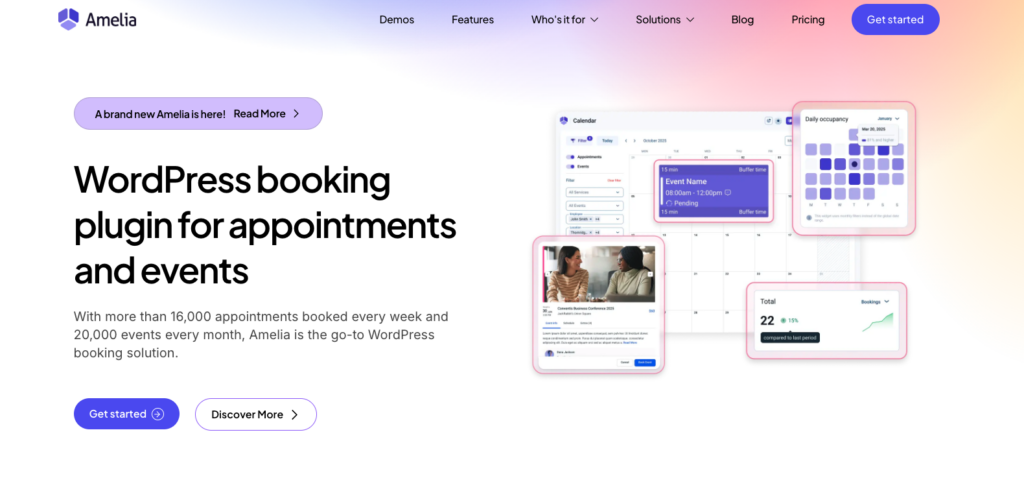
Once you’ve decided how you want to structure your services, the next step is making that model work in practice.
This is where most businesses run into friction. What sounds simple in theory can quickly turn into manual scheduling, pricing workarounds, or limitations in how you offer your services.
Instead of forcing you into one setup, Amelia gives you the flexibility to handle both individual appointments and group bookings without changing how you run your business. You can adjust pricing, manage capacity, and organize sessions in a way that actually matches your workflow.
Pricing by date and time
Not every time slot has the same value, and your pricing should reflect that.
With pricing by date and time, you can adjust your rates based on demand. For example, you might charge more for peak hours, weekends, or high-demand periods, while keeping lower prices during quieter times to fill your schedule.
This gives you more control over how you manage both individual appointments and group bookings. Instead of using one fixed price for everything, you can align your pricing with how your business actually operates throughout the week.
It’s a simple way to increase revenue without changing your services, just by pricing them smarter.
Recurring appointments
If your business depends on repeat clients, you don’t want them booking every session manually.
With recurring appointments, clients can schedule a series of sessions in advance, whether that’s daily, weekly, monthly, or on a custom schedule. This works especially well for services like coaching, therapy, fitness training, or any ongoing program.
Instead of worrying about rebooking, both you and your clients have a clear, consistent schedule. It reduces no-shows, saves time on admin, and helps you keep your calendar filled with regular clients.
For businesses built around long-term relationships, this kind of setup makes a big difference.
Group appointment booking
Not every service needs to be one-on-one. If you’re running sessions with multiple clients, your booking system should support that without extra coordination.
Amelia lets multiple clients book the same time slot while you control how many spots are available. You can set both minimum and maximum capacity for each service, so every session runs the way you planned.
From the client side, it’s straightforward. They pick a time slot, check how many spots are available, and book for the number of people they are bringing. On your end, everything stays organized without manual tracking or back-and-forth.
Pricing by the number of people
In group bookings, pricing doesn’t always have to be fixed per person.
With pricing based on the number of people, you can adjust the total cost depending on how many clients join a session. This gives you more flexibility in how you structure your offers, whether you’re offering small group rates or creating incentives for larger bookings.
It’s especially useful if you want to balance accessibility and profitability. Smaller groups can still be worth your time, while fuller sessions naturally generate more revenue. The best part? Everything updates automatically based on the number of attendees, so you don’t have to calculate anything manually.
Deposit payments
Not every booking needs to be paid in full upfront, but you still want some level of commitment from your clients. With deposit payments, you can split the total price into two parts. A portion is paid during the booking, while the remaining amount is paid on-site.
This works well for higher-priced services where last-minute cancellations can cost you time and revenue. Clients are more likely to show up when they’ve already paid part of the service, while still having flexibility with the remaining payment.
It’s a simple way to reduce no-shows and keep your schedule more predictable without forcing full upfront payments.
Final Thoughts
There’s no single “right” model, only the one that fits how your business operates. Some services depend on one-on-one work. Others benefit from serving multiple clients at once. And in many cases, combining both gives you the most flexibility.
What matters is setting up your booking system in a way that supports your workflow, your pricing, and capacity without adding extra work.
If you’re looking for a way to manage both individual and group bookings in one place, give Amelia a try and see how it works in practice. Set up your services, test different booking models, and adjust as you go.

Explore topics

Read Inspiring Customer Stories
Check out how our user set Amelia for his business