 Spring Deals Are in Full Bloom




 Web Developers and Agencies
  Beauty and Spa Salons, Barbershops
  Yoga Instructors and Studios
  Doctors and Healthcare
  Event agencies, hosts and organizers
  Gyms and Personal Trainers
  Automotive and Car Repairs
  Photographers and Studios
  Coaching and Consulting
  Event Agencies and Hosts
  Appointment Booking
  Scheduling for Your Business
  Booking for WooCommerce Stores
  See How Others Use Amelia


Explore topics
Amelia 9.3 Update Brings More Control to Scheduling and Events
Group Bookings vs. Individual Appointments: Which Model Fits Your Business?
Amelia vs Start Booking: Which Booking Solution Is Better for WordPress Businesses?
Amelia Q1 2026 Update: Improvements, Integrations, and What’s Coming Next
Recurring Appointments Guide: Streamline Your Scheduling & Boost Performance

Read Inspiring Customer Stories
Check out how our user set Amelia for his business
Read the full story
Most businesses know exactly what kind of event they want to host: a workshop, a class, a conference. What many don’t think through carefully is how that event should be structured.
And that’s where problems start.
Choose the wrong structure and you’ll deal with admin chaos, confused attendees, overbooked sessions, or empty time slots that should have generated revenue. Pricing gets messy. Communication gets repetitive. Managing everything becomes harder than it needs to be.
In this guide, we’ll walk through practical scenarios, real use cases, and clear decision points to help you choose between one-time, recurring, and multi-day events with confidence.
Why Event Structure Matters More Than You Think
The way you structure an event affects far more than just the calendar. It influences how easily people can book, how clearly they understand what they’re signing up for, and how much work your team has to do behind the scenes.
First, it impacts ticket sales. When the structure is clear, people can quickly understand what they’re buying. If the setup is confusing, many will simply leave without booking.
It also affects attendance rates. The right structure makes it easier for participants to commit and show up. The wrong one can lead to missed sessions, late arrivals, or cancellations.
Event structure also determines how easy the event is to manage. A well-organized setup reduces manual work, prevents scheduling conflicts, and keeps bookings under control.
At the same time, it shapes the customer experience. Clear scheduling, predictable sessions, and straightforward booking flows make the event feel professional and organized.
Finally, it affects pricing flexibility. Some event formats work best with single tickets, while others allow packages, series pricing, or premium multi-day passes.
When the structure isn’t thought through, problems show up quickly. For example:
- Customers accidentally book the wrong date or session
- Recurring events get overbooked or poorly balanced across weeks
- Attendees are unsure whether their ticket covers one day or the entire program
- Teams end up tracking registrations manually in spreadsheets
These issues don’t just create extra work. They also lead to frustrated attendees, missed revenue opportunities, and unnecessary stress for your team.
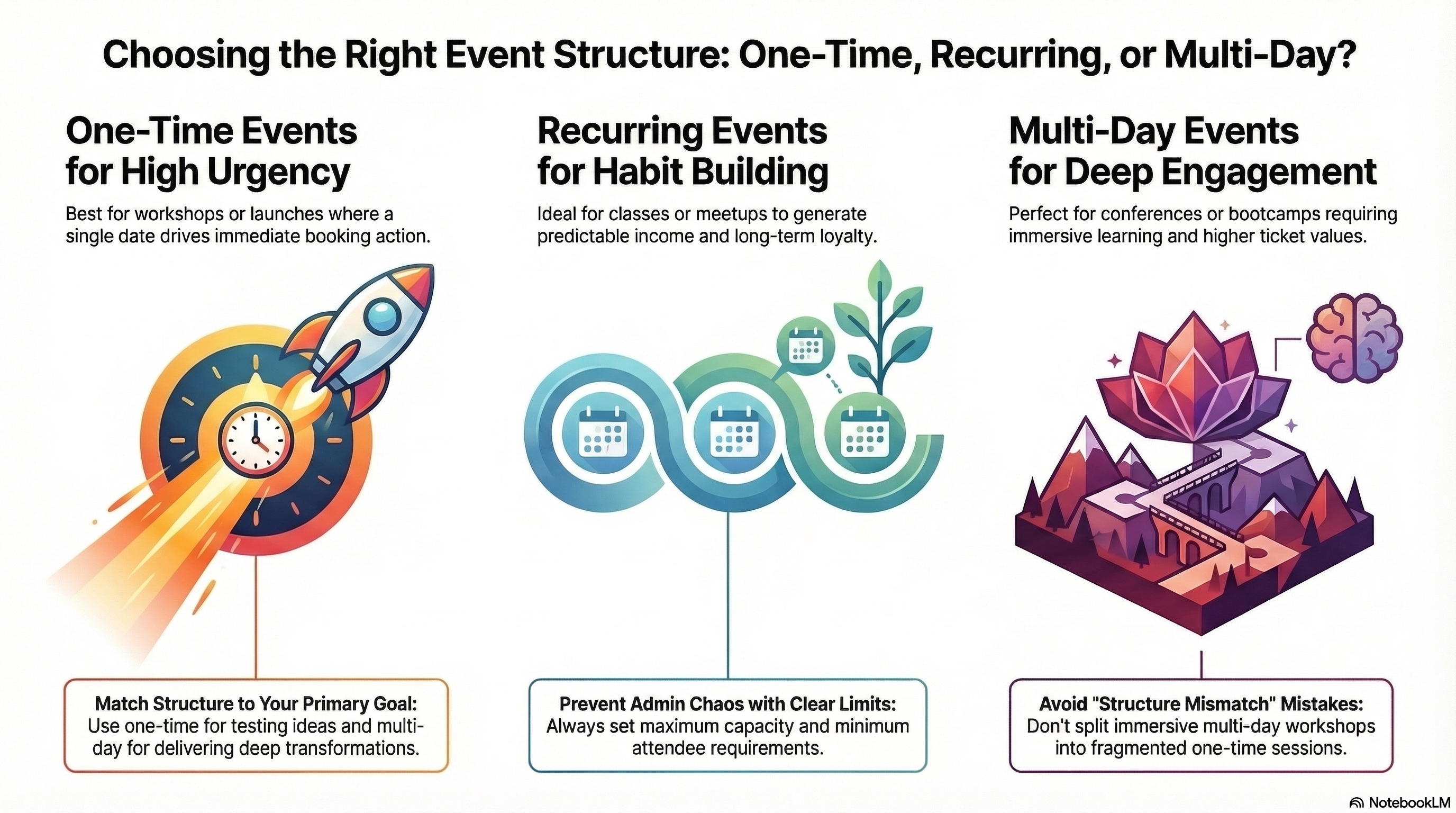
When a One-Time Event Is the Right Choice
What It Is
A one-time event happens on a single date at a specific time and occurs only once. There are no repeated sessions or ongoing schedules. Attendees book a spot for that particular moment, and once it’s over, the event does not repeat unless you create a new one.
Best For
One-time events work best for experiences designed around a specific moment or occasion, such as:
- Workshops
- Launch parties
- Product demonstrations
- Special guest sessions
- Holiday events
These types of events usually rely on a clear date and a focused promotional push.
Pros
One-time events are often the simplest format to manage. They offer:
- Simple setup with only one schedule to manage
- Clear urgency since the event happens once
- Easy promotion with a single date to market
- No recurring management or ongoing scheduling
Because there is only one opportunity to attend, these events often benefit from stronger urgency in marketing campaigns.
Challenges
Despite their simplicity, one-time events also come with a few limitations:
- The revenue window is limited to a single session
- They require effective promotion to fill available spots
- If attendance is low, there is no second opportunity to fill the event
This makes planning and promotion especially important.
Practical Tips
If you’re planning a one-time event, a few practical tactics can improve results:
- Use early-bird pricing to encourage faster bookings
- Set maximum capacity clearly to prevent overbooking
- Send reminder notifications before the event to reduce no-shows
- Consider recording the event so the content can be reused later as a course, replay, or marketing material
When to Choose Recurring Events
What It Is
A recurring event repeats on a regular schedule. Instead of creating separate events for each date, the same event automatically repeats based on the rules you set.
This can include:
- Weekly sessions
- Bi-weekly events
- Monthly meetups
- Custom intervals that match your schedule
Recurring events are designed for experiences that happen consistently over time rather than as a single occasion.
Best For
Recurring structures work especially well for events that rely on routine, community, or long-term participation. Common examples include:
- Fitness classes
- Language lessons
- Support groups
- Ongoing workshops
- Community meetups
In these cases, attendees often return regularly, making a repeating schedule more practical than creating separate one-time events.
Pros
Recurring events offer several operational and business advantages:
- Predictable income from ongoing bookings
- Easier long-term marketing, since the event doesn’t expire after one date
- Habit-building that encourages repeat attendance and loyalty
- Less setup over time, because the schedule is automated
This structure is especially effective for businesses that run classes, training programs, or community-driven events.
Challenges
Recurring events still require some planning to avoid operational issues. Common challenges include:
- Managing cancellations or rescheduling when instructors are unavailable
- Handling holidays or special dates that interrupt the regular schedule
- Maintaining consistent capacity across different sessions
Without proper structure, some sessions may fill instantly while others remain nearly empty.
Practical Tips
To make recurring events run smoothly, consider these strategies:
- Set minimum capacity requirements so you don’t run sessions with too few participants
- Offer package pricing for multiple sessions to encourage repeat bookings
- Send recurring reminders to help attendees stay consistent
- Decide whether participants book individual sessions or a full series
Clear booking rules make the experience easier for both organizers and attendees.
When a Multi-Day Structure Makes Sense
What It Is
A multi-day event runs across several consecutive days as one structured program. Instead of booking individual sessions, attendees register for the full experience and participate throughout the entire schedule.
This format is designed for events where the content, activities, or outcomes unfold over multiple days rather than in a single session.
Best For
Multi-day structures work well for events that require deeper learning, networking, or immersive participation, such as:
- Conferences
- Retreats
- Bootcamps
- Certification programs
- Festivals
These types of events often involve multiple sessions, speakers, or activities that build on each other over time.
Pros
Multi-day events offer several strategic advantages:
- Higher ticket value, since attendees are paying for a full program
- Deeper engagement with the content and experience
- Premium positioning, especially for educational or professional events
- Stronger authority, as longer programs signal expertise and depth
Because participants commit more time, these events often deliver stronger perceived value.
Challenges
Multi-day events also require more planning and coordination. Common challenges include:
- More logistics, such as scheduling multiple sessions and managing speakers or activities
- Higher commitment from attendees, which can make promotion more demanding
- Clear communication requirements, so participants understand the full schedule and expectations
Without clear structure, attendees may become confused about when sessions happen or what their ticket includes.
Practical Tips
To keep multi-day events organized and easy to manage, consider these best practices:
- Clearly state whether the ticket covers all days or individual parts of the program
- Provide a detailed schedule breakdown so attendees know what to expect each day
- Use tiered pricing, such as early-bird tickets or premium access options
- Send structured reminders for each day to keep participants engaged and prepared
How to Decide: A Simple Decision Framework
Choosing the right event structure becomes much easier when you focus on how the experience should work for your attendees and your business. Instead of starting with the format, start with the goal of the event.
Ask yourself a few simple questions:
- Is this a one-time experience or something ongoing?
- Does the event rely on habit or routine?
- Does the experience require multiple consecutive days to deliver value?
- Is urgency an important part of the promotion?
- Do attendees need progression from one session to the next?
Your answers will usually point clearly toward the right structure. For example, a special guest workshop often works best as a one-time event, while a weekly class designed to build skills naturally fits a recurring format. Programs that deliver deeper transformation, like training bootcamps or retreats, usually benefit from a multi-day structure.
Common Mistakes to Avoid
Even good events can run into problems when the structure isn’t planned carefully. Here are a few common mistakes.
Choosing recurring when it should be multi-day
Some programs are meant to be experienced as a continuous journey. Turning them into weekly sessions can break the flow and reduce engagement.
Splitting a multi-day workshop into separate one-time sessions
Creating separate events for each day can lead to fragmented bookings, with attendees joining only parts of the program.
Forgetting capacity limits
Without clear limits, events can easily become overbooked, creating logistical issues and a poor attendee experience.
Not defining minimum attendees
Some sessions only work with enough participants. Without a minimum requirement, you may end up running events that aren’t viable.
Overcomplicating pricing
Too many ticket options or unclear pricing can confuse customers and slow down bookings. Simpler pricing usually converts better.
To avoid these mistakes, check out our event planning tips!
How Amelia Helps You Manage Any Event Structure
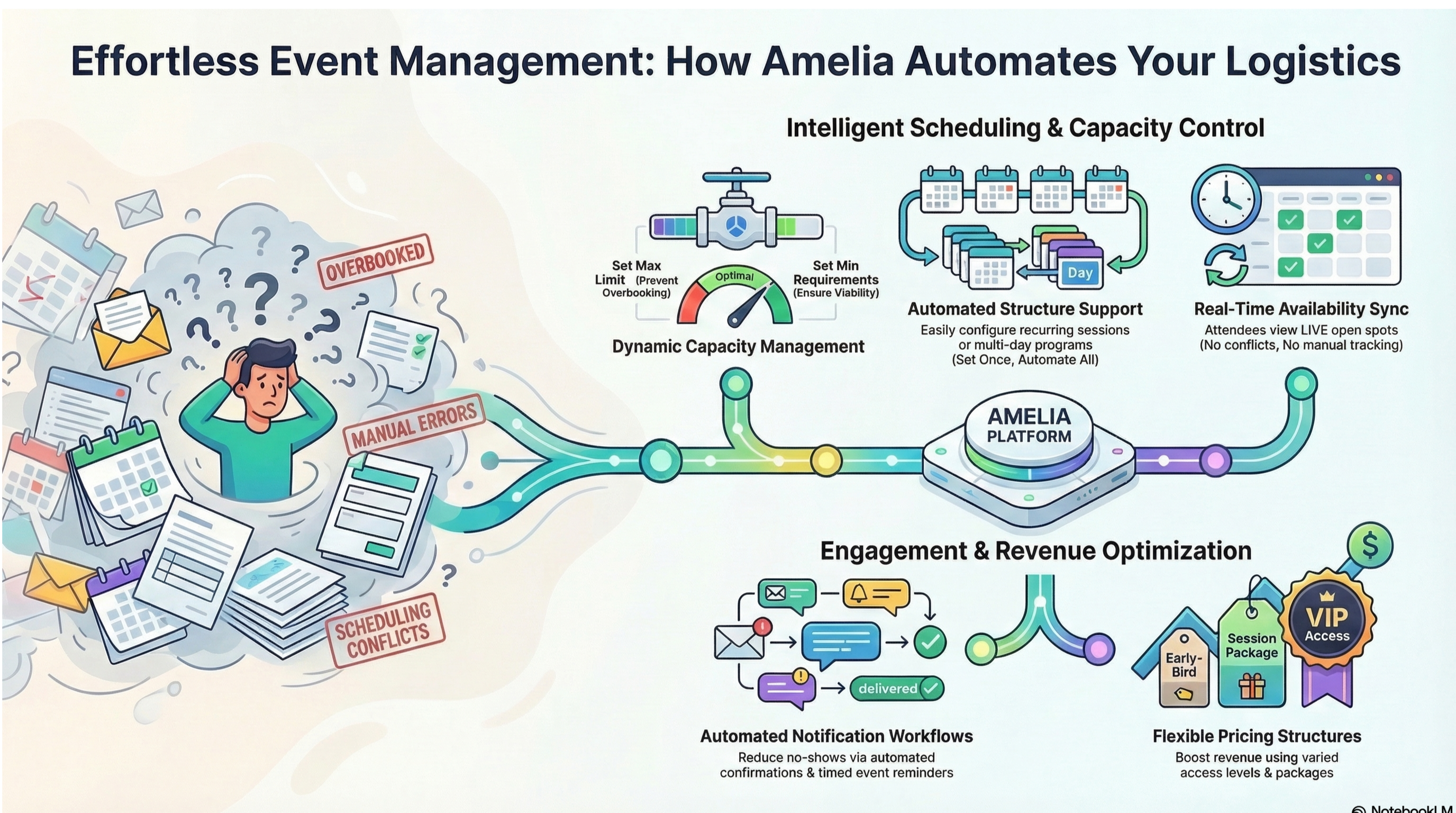
No matter which event format you choose, the real challenge is managing it smoothly. Scheduling, capacity control, and communication can quickly become complicated without the right system in place.
Amelia helps simplify these tasks so you can focus on delivering the event instead of managing logistics.
You can set maximum capacity for each event to prevent overbooking and keep the experience comfortable for attendees. If your event requires a certain number of participants to run, you can also define a minimum number of attendees before the event takes place.
For events that repeat regularly, Amelia allows you to create recurring events without manually setting up each session. If you’re running longer programs, you can also structure multi-day events and manage them as a single experience.
Attendees always see real-time availability, so they know exactly which spots are open before booking. Once someone registers, automated notifications and reminders help reduce no-shows and keep everyone informed.
You can also use flexible pricing options to support early-bird tickets, packages, or different access levels depending on the event format.
Together, these features make it easier to manage one-time events, recurring sessions, and multi-day programs without adding extra administrative work.
Final Thoughts: Structure First, Then Promotion
Before focusing on promotion, make sure the event itself is structured the right way. Even the best marketing can’t fix a confusing schedule, unclear booking rules, or poorly organized sessions.
Start by deciding how the event should function. Should it happen once, repeat regularly, or run across several days? When the structure is clear, everything else becomes easier to manage and promote.
Simple setups also scale better. Clear schedules, defined capacity, and straightforward pricing make the experience smoother for both your team and your attendees.
In the end, a well-structured event doesn’t just reduce operational stress. It also creates a better booking experience, improves attendance, and helps maximize revenue.
 Back to Previous


Read Inspiring Customer Stories
Check out how our user set Amelia for his business
Read the full story